Oslo, the capital of Norway, is a vibrant city where modern urban life meets breathtaking natural beauty. Nestled between the Oslofjord and lush forests, the city offers a mix of cutting-edge architecture, historic landmarks, and cultural institutions like renowned museums and galleries.
Norway: Oslo – The Fram Museum
Like the neighbouring Kon-Tiki Museum, the Fram museum is named after another sea-faring vessel, but this one was designed with a different purpose in mind, to survive in the harsh waters of the Arctic and Antarctic, where it could potentially be trapped in the ice flows. Its round bottom and reinforced hull were designed to be pushed upwards and sit on the ice until the ice later melted. The Fram is the strongest wooden ship ever built and still holds the records for sailing farthest north and farthest south.
The Fram was the first ship specially built in Norway for polar research. She was used on three important expeditions: with Fridtjof Nansen on a drift over the Arctic Ocean 1893-96, with Otto Sverdrup to the arctic archipelago west of Greenland – now the Nunavut region of Canada – 1898-1902, and with Roald Amundsen to Antarctica for his South Pole expedition 1910-12.
I love reading books about great and extreme adventures, such as the Kon-Tiki, but my favourite reads have been about polar exploration. I have read several books on those explorations of the Poles, especially the South Pole, so I was fascinated to see one of the ships that was used in these great adventures. The Fram is very special as it was used by Roald Amundsen for his successful race to be the first team to reach the South Pole on 14 December 1911.
When you enter the museum, the first thing you see is the Fram. It sits neatly inside the museum’s A-frame structure with its masts reaching up into the apex of the building’s roof. The ship was incredibly beautiful. Before looking around the rest of the museum we headed up to the third level and boarded the deck of the ship. We love large sailing ships with their blocks and tackles, together with the metres and metres of rope to hoist and support the sails. The lighting inside the museum is kept low to protect the wooden beams and decking from light damage, which creates an eery atmosphere. From the deck, we climbed down below. In these sailing ships the ceilings were low, and the passageways narrow. There were a lot of visitors on the ship, so it was hot and crowded below deck, this got to Karen who had to make her way out while I carried on. Passing through the Fram lower decks you get to see the living quarters of the men, which were tiny and where they ate and worked. The was a piano so they could entertain themselves, a workshop to make repairs to the ship and sewing machines so they could fix any damage to the sails. A lot of space aboard was given to storage, for the dogs and sledges and provisions, should they need to spend months trapped in the ice.
Eventually, I worked my way back to the deck of the Fram and rejoined Karen.
Four levels of walkway go around the outside of the Fram. Along these walkways are displays of articles from the polar expeditions and panels packed with stories of the building of the Fram, the polar explorations and the men who went on these great adventures. You could probably spend days just taking all this in.
From the main Fram hall, there is an underground passageway that leads to another exhibit hall, which focuses on other Norwegian explorations of the polar regions. The centrepiece of this hall is another ship. The Gjøa was the first ship to be sailed through the entire Northwest Passage. Roald Amundsen and his six companions accomplished this in 1903-06. The Gjøa had fallen into disrepair over the years but was saved and brought inside the Fram Museum to preserve her for posterity. Inside this hall, there were other exhibits on polar expeditions using other means of travel, including aircraft.
Off the Gjøa hall was a small theatre that was showing a short film about the Norwegian polar explorers, which was very interesting to watch.
Planning your visit to the Fram Museum
Bicycle:
Oslo Bysykkel is available 365 days a year.
By private car:
Public parking in Bygdøynesveien 37 before Bygdøynes.
Public transport:
Bus 30 from Jernbanetorget, City Hall and Solli Plass every 10 minutes.
Ferry:
Bygdøyfergene From Rådhuskaien 4 to Bygdøy from April to October, every 20 minutes. Stop no. 2 Bygdøynes, 200 meters from the Kon-Tiki Museum.
Getting around Oslo
Thanks to Oslo’s excellent public transportation system Ruter, it is easy to travel around the city. Distances between attractions are often quite short, so you can explore a lot of the city by walking or biking.
Public transport
All public transport in Oslo and the surrounding boroughs are included in one ticketing system. That includes city and regional buses, trams, undergrounds, local trains and ferries. The ferries to Bygdøy are not included.
Tickets and zones
One of the easiest ways to get and manage tickets for public transport is using the mobile app Ruter. If you prefer having physical tickets in your pocket, you can purchase them at the Oslo Visitor Centre, at Ruter’s customer service centre, and in Narvesen and 7-Eleven shops.
Get an overview of the prices for tickets here.
Please note that if you want a physical version of weekly, monthly or annual tickets, you need a reusable plastic travel pass costing 50 NOK. All tickets are transferable.
Oslo and the surrounding boroughs are divided into several zones. All of Oslo, including the last stops of the subway system, is included in zone 1. If you want to go to Oslo Airport Gardermoen, you need a ticket for four zones. If you have a period ticket of the Oslo Pass, you can buy the remaining zones separately.
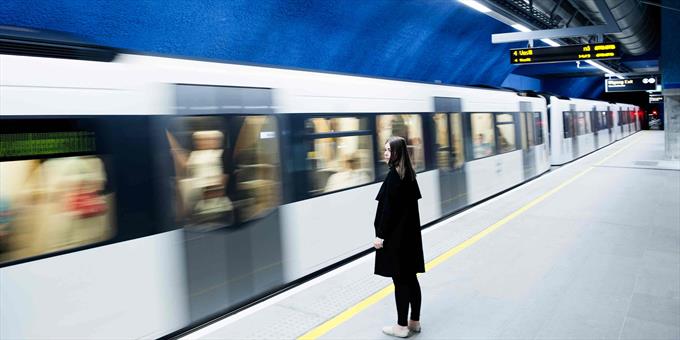
Ticket prices for public transportation in Oslo
See all ticket prices for public transport in Oslo and find out where you can buy tickets.
Oslo Pass
If you are planning to spend a few days in Oslo, using the public transport system and visiting several of the city’s attractions then the Oslo Pass could be a good option for you. We purchased the pass for our stay and it was great value for money and made our lives easier. Find out more about the Oslo Pass and what is included here.
With the Oslo Pass, you can travel for free within zone 1 (Oslo) and zone 2. In addition to Ruter’s public transport network, also the ferries to Bygdøy are included in the Oslo Pass.
It comes as an app as well, so you can handily have it on your phone when using the transportation or visiting one of the tourist attractions.
Eating out for vegans in Oslo
While Oslo might not be the most vegan-friendly city in the world, there are still plenty of high-quality options to choose from.
- Oslo Raw – Address: Skovveien 16, 0257 Oslo, Norway osloraw.no
- Dirty Vegan at Barcode Street Food – Dronning Eufemias gate 14, 0191 Oslo, Norway https://www.dirtyvegan.no
- Nord Vegan – Kristian IVs gate 15B, 0164 Oslo, Norway 3 https://www.nordvegan.no/
- Cultivate – Helgesens gate 18a, 0553 Oslo, Norway – https://cultivatefood.no
- Torggata Botaniske – Torggata 17B, 0183 Oslo, Norway https://www.torggatabotaniske.no/
- Veggie da Luca – Thorvald Meyers gate 34, 0555 Oslo, Norway https://delideluca.no/
- Silk Road at Oslo Street Food – Torggata 16, 0181 Oslo, Norway – https://www.oslo-streetfood.no/silk-road
The best time to visit Oslo
Positioned in the southern part of Norway, Oslo experiences a Humid continental climate; no dry season, warm summer, according to the Köppen climate classification, symbol Dfb. The climate bears a strong influence of Gulf Stream, thus enjoying a warmer climate than other regions of similar latitude around the world.
For Oslo annually, monthly average temperatures range between -6.8°C (19.8°F) to 21.5°C (70.7°F), showing significant fluctuations as the season change. Moreover, rainfall is experienced all year round, with monthly averages ranging from 36mm (1.42″) to 90mm (3.54″). The city endures between 4 and 8 rainy days per month, with the maximum number of rainy days in August and November.
The best time to visit Oslo
For visitors, the best time to visit Oslo is usually between June and August. Temperatures during these months range from 15.1°C (59.2°F) to 21.5°C (70.7°F), which is quite pleasant for outdoor activities. The sea temperature is at its highest, around 17.3°C (63.1°F) in June and 17.9°C (64.2°F) in August. These months also provide the longest daylight hours, between 17.9 and 18.7 hours, providing ample opportunity to explore the city’s attractions.
The worst time to visit Oslo
The winter season, from December to February, is regarded as the least attractive time to visit Oslo due to the cold temperatures and short daylight hours. The average temperatures plummet to cold levels between -6.8°C (19.8°F) to -0.9°C (30.4°F), and daylight is restricted to between 6.1 and 9.2 hours. Additionally, the sea temperature is at its coldest, dipping to between 3°C (37.4°F) to 4.2°C (39.6°F), making it unsuitable for water-based activities.
Where to stay in Oslo
1. Mid Range: Hotell Bondeheimen
This central hotel is just 100 metres from the National Gallery and Oslo’s main shopping street, Karl Johans Gate. Free WiFi and a popular in-house restaurant is available. The Oslo Opera House is 1.3 km away.
Hotel Bondeheimen’s spacious rooms also include cable TV, a tea/coffee maker and ironing facilities.
Hotel Bondeheimen’s restaurant, Kaffistova, specialises in traditional Norwegian food such as potato dumplings and cod.
Tinghuset Tram Stop is just around the corner from Bondeheimen and is a 4-minute ride from Oslo Central Station.
2. Luxury – Hotel Continental
The elegant Hotel Continental is centrally located in Oslo, only 150 metres from Oslo’s main street, Karl Johan. It is the only 5-star hotel in Norway, and offers free in-room Internet access.
The individually decorated rooms at Continental Hotel include a cable TV, minibar and an in-room safe. Bathrooms include amenities and a separate shower and bath.
Leisure options include a free 24 hour gym and a lobby lounge featuring Edward Munch lithographs.
Guests can enjoy fine dining at Restaurant Eik Annen Etage. The historic Theatercaféen has been the Oslo’s most popular dining and meeting place for over 100 years.
3. Budget -Bunks at Rode
Situated in Oslo, Bunks at Rode has a shared lounge, terrace, bar, and free WiFi throughout the property. The property is around 4.1 km from Akershus Fortress, 6.9 km from Sognsvann Lake and 2.4 km from Oslo Bus Terminal. The property is non-smoking and is located 2.5 km from Oslo Central Station.
Certain rooms are fitted with a kitchenette with a fridge, a microwave and a stovetop. The rooms have bed linen.
