
Ananuri Fortress Complex is a remarkably well-preserved medieval castle perched above the Zhinvali Reservoir in Georgia’s Mtskheta-Mtianeti region, roughly 72 kilometres north of Tbilisi along the Georgian Military Highway. Dating from the 13th century and once the seat of the Aragvi Eristavi — the feudal rulers who controlled this vital mountain corridor — the complex contains two churches, a defensive tower, and imposing curtain walls that still stand to full height. The Church of the Assumption is decorated with intricate stone-carved grapevines and the Georgian cross of Saint Nino. Whether arriving on a day trip from Tbilisi or pausing on the journey north towards Gudauri and Kazbegi the fortress and its lakeside setting make a stop that rewards time spent wandering slowly through its layers of history.
Georgia: Stalin’s Birthplace – The Gori Stalin Museum
🏘️ Gori, Georgia: The Small Town That Gave Us Stalin
I’ll be honest with you — before I went to Gori, I couldn’t have told you where it was on a map, let alone what it was famous for. I knew Georgia had wine, mountains, and a worrying number of hairpin bends, but Gori itself hadn’t come up in my reading at all. It’s not a big place. By the standards of the region it’s barely a dot — the kind of provincial market town you’d drive through without a second glance, if it weren’t for one rather enormous historical accident. That accident was a baby born there on the 18th of December 1878, christened Ioseb Jughashvili, and known to the rest of us, somewhat more memorably, as Joseph Stalin.
I’ll admit this came as a genuine surprise to me, and I felt slightly ashamed of the gap in my knowledge. Here was a man responsible, by the more conservative estimates, for something like six million deaths, and by the less conservative ones, over twenty million — through famine, through the gulags, through purges, through sheer bureaucratic callousness on a scale that’s hard to get your head around — and he’d started out in a two-room cottage in a dusty Georgian town that today sells fridge magnets with his face on them. You couldn’t make it up, and if you tried, nobody would believe you.
👞 A Cobbler’s Son with a Chip on His Shoulder
Stalin’s father, Besarion Jughashvili, was a cobbler by trade, though by most accounts a rather unsuccessful and increasingly drunk one. The family home life, from what I gathered, was not what you’d call stable — there was poverty, there was violence, and there was a father who drifted in and out of the picture as his business and his liver both failed him in equal measure. His mother, Ketevan — usually anglicised as Ekaterine — was a different sort altogether. She took in washing and cleaning to make ends meet, and she was absolutely dogged in her determination that her son would get an education, which in that time and place was no small ambition for a working-class Georgian woman.
In 1888 she got him into the Gori Church School, a modest establishment that nonetheless gave the young Ioseb his first taste of formal education. By all accounts he was a sharp pupil — quick, bookish, good with languages — but he also had a reputation as the naughtiest boy in the class, which strikes me as rather a consistent character trait when you consider what came later. Bright and badly behaved is not, in my experience, a combination that tends to improve with age, and in his case it certainly didn’t.
At sixteen he won a scholarship to the Tiflis Theological Seminary, a serious achievement by any measure, and one his mother took as confirmation that he was destined for the priesthood. She was, to put it mildly, barking up the wrong tree. Once there, young Ioseb got hold of a copy of Marx’s Das Kapital, taught himself enough Russian to get through it properly, and came out the other side a committed atheist with a deep contempt for the institution that was meant to be training him for holy orders. He stopped bowing to the monks, started agitating among the other students, and in 1899 was duly expelled. In later life he preferred to say he’d been thrown out for revolutionary activity, which does admittedly sound a lot more dashing than “persistent insubordination and failing to turn up,” but I rather suspect the truth is closer to the latter. Still, you can hardly blame a man for improving his own legend when he’s got an entire state propaganda machine to do it for him.
🔨 Bank Robberies, Exile, and an Awkward Compliment from Lenin
What followed his expulsion was roughly fifteen years of the sort of underground revolutionary life you’d expect from a Russian novel — strikes organised, pamphlets printed, funds raised through what were euphemistically called “expropriations” and, in plainer English, bank robberies, and a string of arrests followed by exiles to Siberia, most of which he simply walked away from. He was, whatever else you say about him, resourceful. Lenin, watching from a comfortable distance, took a shine to him and called him his “wonderful Georgian,” which with hindsight ranks among the more spectacular misjudgements in twentieth-century politics.
By 1922 Stalin had got himself appointed General Secretary of the Communist Party, a job that at the time nobody else particularly wanted because it looked like dull administrative drudgery. That, of course, was precisely the point — it let him quietly stack the party machinery with his own people while everyone else was busy jostling for the glamorous jobs. Lenin twigged what was happening before he died in 1924, and in a private memorandum warned that Stalin was too rude, too capricious, and ought to be removed from his post. The note was suppressed, conveniently, by the very apparatus Stalin now controlled, and within a few years he had outmanoeuvred Trotsky, Bukharin, Zinoviev and the rest of them to become the undisputed master of the Soviet Union. It’s a genuinely remarkable piece of bureaucratic infighting, if you can stomach admiring it, which I rather feel you shouldn’t.
☠️ The Thirty Years That Followed
I won’t dwell too long on what came next, because entire libraries have been written about it and I’m not going to improve on them in a travel blog, but a rough sketch is unavoidable if you’re going to understand Gori’s museum and why it’s such an uncomfortable place to visit. In the early 1930s, Stalin forced the collectivisation of agriculture across the Soviet Union, and the resulting famines killed millions, with Ukraine’s Holodomor being the worst of them by a horrifying margin. From 1936 to 1938 came the Great Purge, in which hundreds of thousands were shot outright and millions more were shipped off to the gulag system, often on the flimsiest of pretexts or none at all.
In 1939 he signed his non-aggression pact with Hitler, which bought him a couple of years of uneasy peace, and then seemed to be caught almost comically off guard when Germany invaded in June 1941 regardless. He recovered his nerve, rallied the country, and eventually led the Soviet Union to victory in 1945 — at a cost historians generally put somewhere around twenty-seven to thirty million Soviet lives, military and civilian combined, which is a figure so large it stops meaning anything useful as a number and starts meaning something only as a horror. He sat as an equal with Churchill and Roosevelt at Tehran in 1943 and Yalta in 1945, redrawing the map of post-war Europe with the casual confidence of a man who knew nobody was going to stop him. He died on the 5th of March 1953, following a stroke, and — in a detail I found weirdly more chilling than almost anything else in his biography — he apparently lay unattended on the floor of his dacha for several hours beforehand, because the guards and staff were too terrified of him to intervene without being explicitly told to. That one fact tells you more about the climate of fear he created than any number of casualty statistics, and it’s stayed with me since.
🏛️ The Museum: A Grand, Faintly Embarrassing Shrine
The Stalin Museum in Gori opened in 1957, just four years after his death, in a grand and frankly rather pompous building done up in a heavy, Stalinist-Gothic style. Construction had actually begun back in 1951, while the man himself was still alive and presumably rubbing his hands together at the thought of it. Inside, you’re led chronologically through six halls — photographs, paintings, personal effects, gifts sent by foreign communist parties and admiring dignitaries, and a fair bit of office furniture that I can only assume somebody decided was historically significant. Most of the information panels were in Georgian only, which did rather limit how much I could absorb beyond the pictures, but the pictures themselves told quite a lot. There’s something properly unsettling about walking past case after case of carefully curated personal belongings — a pipe here, a coat there — knowing what the man who owned them actually did with his time.
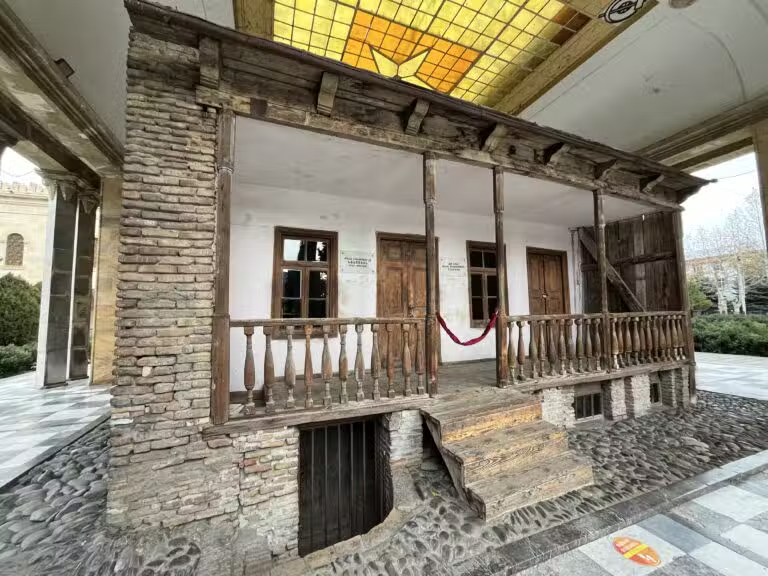
Just outside the main building, kept under an elegant little Greco-Italianate stone canopy that looks, not coincidentally, rather like a shrine, sits the original wooden cottage where Stalin was born. It’s tiny — two rooms, about as humble as housing gets — and standing next to it, trying to square that ordinary little dwelling with everything that followed, is a genuinely strange experience. It’s the historical equivalent of looking at a photograph of someone as a harmless-looking baby and knowing what they grew up to do.
And then, because apparently the museum needed one more flourish, there’s the railway carriage. It’s an armour-plated Pullman carriage, painted a sombre green, weighing a frankly absurd eighty-three tonnes, which Stalin used for travel from 1941 onwards, including his journeys to the Tehran and Yalta conferences. It was recovered from railway yards at Rostov-on-Don in 1985 and installed beside the museum, and I confess I can’t quite work out whether it’s meant to impress visitors or just remind them how far removed from ordinary Soviet life the man travelled, quite literally, in his own armoured bubble.
After the Soviet Union collapsed, there was serious talk of converting the whole museum into something called a Museum of Russian Aggression, which would have been a rather pointed bit of reinvention. In 2012, Gori’s municipal assembly voted the proposal down, and so the museum remains, more or less, what it has always been — a slightly uncomfortable, oddly reverent monument to a man who went from a two-room cottage to redrawing the world, in the worst possible sense.
I’d intended to join a guided tour, which would have helped enormously given the Georgian-only panels, but I was running late, as I generally am, and so I did what any self-respecting, mildly disorganised traveller does in that situation: wandered about looking at things I didn’t fully understand, told myself I was “absorbing the atmosphere,” took a few photographs I’d probably never look at again, and trundled back to the car feeling vaguely educated and thoroughly unsettled in equal measure.
🪞 Reflections
Looking back on it, Gori is one of those places that leaves you with more questions than answers, which I suppose is rather the point of visiting it at all. It’s an ordinary, slightly scruffy provincial town that happens to have produced one of the most consequential and destructive men of the twentieth century, and it hasn’t quite decided — and perhaps never will — whether it wants to disown him, celebrate him, or simply shrug and keep selling the fridge magnets. There’s no tidy moral to tie it up with. You leave a place like Mtskheta or Lake Sevan feeling quietly uplifted; you leave Gori feeling a bit queasy, a bit thoughtful, and more than a little relieved to be getting back in the car. Which, on reflection, is probably exactly how a museum to Stalin ought to make you feel.


Planning Your Visit to the Gori Stalin Museum
📍 Location
The museum stands on Stalin Avenue in central Gori, roughly 500 metres from the city’s medieval fortress. The address is 32 Stalin Avenue — one of the very few streets in the former Soviet world still bearing that particular name — and the building announces itself early: an imposing white-and-ochre structure in a style that blends Italian Gothic arches with Stalinist monumentalism, sitting within a formal garden flanked by a large statue of Stalin that was controversially relocated here from the city hall in front of which it had stood for decades. The building was constructed around the wooden house where Stalin was born, which now sits under a rather pompous neoclassical canopy in the museum grounds, and it was originally designed, apparently, by Lavrentiy Beria — Stalin’s feared security chief — giving the architecture a provenance almost as unsettling as the collection inside.
The museum complex takes in three elements: the main exhibition halls, Stalin’s preserved childhood home, and the armour-plated Pullman railway carriage in which he travelled to Tehran and Yalta, parked on a short stretch of track alongside the main building and visitable as part of the full ticket. The carriage, fitted out in a heavy-handed version of mid-century comfort, is one of the odder things you are likely to sit in.
The tourist information office for Gori is located directly behind the museum, which gives some sense of the extent to which the whole town understands what it is people have come to see.
✈️ Getting There
🚌 By Marshrutka from Tbilisi
The most popular and economical option is the marshrutka — the shared minibus that is the workhouse of Georgian public transport. Minibuses to Gori depart regularly from Didube bus station in Tbilisi, roughly every 20 to 30 minutes throughout the day. The journey takes between one and one and a half hours depending on traffic, and the fare is in the region of 5 to 7 GEL. Didube is served by the Tbilisi Metro, making it straightforward to reach from most parts of the city. The marshrutka drops passengers in central Gori, within walking distance of the museum, though the distance from the bus station itself is considerable enough that most visitors opt for a short taxi ride rather than the walk.
🚆 By Train from Tbilisi
Trains on the Tbilisi–Kutaisi line stop at Gori, with departures from Tbilisi at around 08:30 and 08:50 each morning. The journey takes roughly one and a half to two hours, and tickets cost between 5 and 13 GEL depending on the class of travel. Tickets are bought on board rather than online. The train and bus stations are both a fair walk from the museum, and a taxi from either is the sensible way to cover the final stretch.
🚗 By Taxi or Private Transfer from Tbilisi
Hiring a taxi for the day from Tbilisi is a popular option for those who want to combine Gori with other stops along the same route — most commonly Mtskheta and the ancient cave city of Uplistsikhe, which lies only about 15 kilometres from Gori and makes for a natural pairing. Agree a price before setting off, as fares are not metered; a round trip from Tbilisi with waiting time typically costs in the range of 80 to 120 GEL. Taxis can also be found on the north side of the Stalin Museum in Gori itself, though drivers at popular tourist spots tend to open negotiations rather high.
🗺️ By Organised Day Tour from Tbilisi
A number of operators in Tbilisi run guided day tours that combine Gori with Mtskheta, Jvari Monastery and Uplistsikhe in a single circuit of around nine hours. These tours travel by air-conditioned minibus and are led by English-speaking guides who provide context that the museum’s own labelling — much of which is in Georgian and Russian only — does not always supply. The tour price generally covers transport and guiding but not entry fees, which are paid separately on arrival.
🚶 Getting Around
Gori is a compact city and the museum is its unambiguous centrepiece, visible and signposted from most parts of the centre. On foot, the museum is easily combined with the Gori Fortress, which rises on a rocky outcrop above the old town and repays the climb with a broad view over the surrounding plain, and several other small museums lie within walking distance along Stalin Avenue and the streets immediately adjacent. The Historical Ethnographic Museum, the Great Patriotic War Museum and the newer Museum of Soviet Occupation are all within 600 metres of the Stalin Museum entrance, and a full circuit of all five takes between five and six hours at a reasonable pace.
Taxis within Gori are inexpensive and plentiful, found on the north side of the museum or flagged along the main avenues. For the trip out to Uplistsikhe, the ancient rock-hewn city about 15 kilometres east of town, a taxi or a morning train (departing from Gori at around 10:00 and returning around 17:00) are both practical options and it is well worth the half-day if time allows.
The museum itself is not wheelchair accessible, and neither is Stalin’s childhood home or the railway carriage.
🎟️ Inside the Museum
The main building contains six exhibition halls arranged on the ground and upper floors, following Stalin’s life in broadly chronological order. The rooms are heavy with photographs, personal possessions, paintings and official gifts — the kind of accumulation that makes the place feel less like a critical museum and more like a slightly overwhelming house of relics. There are gifts from foreign leaders, documents from the wartime conferences, portraits and busts in every medium, and a recreation of his Kremlin office. An English-speaking guide is available and is worth taking: the exhibition labels offer limited translation, and the guide provides context and occasionally some candour that the displays themselves do not.
The basement hall on the repressions is the single room that steps out of the prevailing atmosphere of commemoration, though visitors expecting a frank reckoning with the Gulag system will likely find it incomplete. Most travel accounts suggest leaving it without fully resolved feelings, which in a sense is what a museum like this does to most people.
Outside, the childhood home — a small, two-roomed wooden cottage of genuine modesty — stands under its columned canopy and can be visited as part of the full ticket. So can the railway carriage, which takes a few minutes to walk through but lingers in the memory considerably longer. A gift shop sells the expected range of busts, coasters, mugs and postcards, the trade in which is apparently robust enough to confirm that Stalin-tourism is very much a going concern in Gori.
Coach parties from Tbilisi tend to arrive between late morning and early afternoon, so arriving at opening time gives a considerably more contemplative experience.
📋 Visitor Information
| Detail | Information | Notes | Contact / Source |
|---|---|---|---|
| Address | 32 Stalin Avenue, Gori, 1400 | Central Gori; 500m from the fortress | — |
| Telephone | +995 270 27 52 15 | Museum main line | — |
| Opening Hours | Daily; closed New Year’s Day and Easter | Seasonal hours may vary; verify before visiting | Check museum website or call ahead |
| Entry Fee | 15 GEL per person (full ticket including guided tour, childhood home and railway carriage) | Credit cards accepted; tickets available in person only, no advance booking required | Approx. £4.50 / $5.50 at current rates |
The Best Time to Visit Georgia
🌸 Spring (March–May)
Spring is widely considered one of the finest times to visit Georgia. Temperatures climb gently from the cool of late winter — Tbilisi averages around 12–18 °C by April — and the landscape transforms dramatically. The foothills of the Greater Caucasus turn a vivid green, wildflowers carpet the valleys of Kakheti, and the orchards of Samtskhe-Javakheti erupt into blossom. Rainfall is moderate and spread throughout the season rather than concentrated into heavy downpours, keeping the air clean and the mountains sharp against the sky.
The cultural calendar is also lively. Easter (Aghdugseba) is one of the most atmospheric celebrations in the Georgian Orthodox calendar, marked by candlelit processions, midnight church services, and family gatherings. Wine lovers benefit from visiting in May, when the previous autumn’s vintage is settling nicely and producers open their cellars for tasting. Crowd levels remain manageable; hotels and guesthouses in Tbilisi’s Old Town are available without advance booking pressure, and the mountain resorts such as Kazbegi and Mestia are accessible but not yet overwhelmed.
What to pack. Bring layers you can peel off — a light fleece, a waterproof jacket, and a packable umbrella. Comfortable walking shoes with grip are essential for wet cobblestones. Evenings remain cool until late April, so a mid-weight jumper pays dividends. Add a light scarf for church visits.
☀️ Summer (June–August)
Summer is Georgia’s peak tourist season, and for good reason. Long days, reliably sunny skies, and warm temperatures — often reaching 30–35 °C in Tbilisi and the lowland river valleys — make it ideal for those who want heat and activity in equal measure. The mountain regions offer a natural escape: Svaneti and the Kazbegi area sit at altitude and remain pleasantly cool, making them busy but spectacular destinations for hikers and trekkers. The Caucasus Trail draws serious walkers from across Europe between June and August.
The Black Sea coast around Batumi is in full swing during summer, with beach resorts, botanical gardens, and a lively restaurant and bar scene. Tbilisi itself hosts numerous festivals — the Tbilisi Open Air music festival in late June is a particular highlight — and outdoor dining along Rustaveli Avenue and the banks of the Mtkvari River reaches its zenith. The downside is congestion: popular sites such as Vardzia cave city, the Alazani Valley wine estates, and the Gergeti Trinity Church above Kazbegi are genuinely crowded. Prices rise sharply in July and August, and booking accommodation several weeks ahead is strongly advisable.
What to pack. Lightweight, breathable clothing is essential — linen and cotton fabrics are ideal. Sun cream, a wide-brimmed hat, and sunglasses are non-negotiable for the lowlands. For mountain excursions, add a waterproof layer and a warm fleece, as altitude weather changes rapidly. Sturdy hiking boots if you plan to trek. A modest wrap or shawl for monasteries.
🍂 Autumn (September–November)
Autumn rivals spring as Georgia’s most rewarding season, and for many travellers it edges ahead. September and October bring the Rtveli — the grape harvest — which is the defining event of the Georgian agricultural and cultural year. Vineyards across Kakheti turn gold and amber; families and friends gather to tread grapes by foot in traditional clay qvevri buried in the earth, and wine flows freely at communal feasts known as supras. Temperatures are comfortable — highs of 22–26 °C in September, cooling to 12–15 °C by October — and the crowds of high summer have thinned.
The forests above Borjomi and around Signagi put on a spectacular display of autumn colour, and photography conditions in the mountains are outstanding as the first dustings of snow appear on the high peaks while the valleys remain warm. November brings a marked change: colder temperatures arrive, some mountain passes close, and rainfall increases. Early November can still be pleasant in the cities, but late November signals the onset of the Georgian winter proper.
What to pack. A versatile mid-layer system works best — a long-sleeved base, a warm jumper, and a windproof outer. Sturdy shoes or boots that handle mud are worth the bag space, particularly for vineyard visits. Bring a compact tripod if you photograph landscapes. A small hip flask for the inevitable impromptu supra is entirely appropriate.
❄️ Winter (December–February)
Winter divides cleanly into two very different experiences. In the mountain resorts — particularly Gudauri and Bakuriani — it is the liveliest and most purposeful season of all. Gudauri, perched at around 2,200 metres on the Georgian Military Highway, receives substantial snowfall and operates well-maintained ski runs catering to a growing international clientele. The ski season typically runs from December through March, and February half-term sees the resort at its most energetic. Lift queues are shorter and prices more reasonable in January.
In Tbilisi and the lowlands, winter is quiet and atmospheric. The city’s ancient churches and medieval streets take on a particular beauty in the low winter light, and the absence of tourist crowds allows for unhurried exploration of the Narikala Fortress, the sulphur baths of Abanotubani, and the vibrant Dezerter Bazaar. Christmas (7 January in the Orthodox calendar) and New Year are celebrated with great warmth: the Alilo procession on Orthodox Christmas morning through Tbilisi is one of the most moving public events in the Georgian year. Road access to some mountain villages and monasteries may be limited by snow, and the Gergeti Trinity Church above Kazbegi requires a 4WD vehicle or a guide. Temperatures in Tbilisi hover around 3–8 °C, occasionally dipping below zero.
What to pack. Warm, windproof and waterproof outer layers are essential. For skiing, full ski kit (hire is available at Gudauri). Thermal underlayers, warm socks, and insulated waterproof boots. A good hat and gloves. Hand warmers are welcome in the mountain air.
🏆 Overall Best Time to Visit
For most travellers, September and October represent Georgia’s golden window. The harvest season brings the country’s deepest cultural traditions to the surface, the landscape is at its most photogenic, temperatures are comfortable for both city exploration and mountain excursions, and the frenetic pace of the high-summer rush has subsided. Spring — particularly April and May — runs a very close second, offering similarly pleasant conditions with the added bonus of blossom and the Orthodox Easter celebrations. Both seasons reward the traveller with a Georgia that feels lived-in and generous rather than packaged for tourism.


Related
More to Explore


Prometheus Cave near Kutaisi is western Georgia's most celebrated natural wonder — a vast, illuminated limestone system of stalactites, underground rivers and cathedral-sized chambers stretching deep beneath the Imereti hills, opened to visitors in 1986 and named for the mythological titan of the Caucasus.

Kutaisi is western Georgia's historic and cultural heart — a city of cathedral ruins, ancient monasteries, subterranean caves and forested canyons that holds some of the South Caucasus's most significant monuments yet sees a fraction of the crowds that flock to Tbilisi.