
Cruise along the Chicago River on an architecture boat tour that showcases over 50 iconic skyscrapers with expert commentary covering the city's remarkable design heritage from its post-fire rebuilding era through to its modern glass and steel skyline.
United States: Chicago: Illinois’s City of Blues and Bridges
Contents
1. About Chicago
2. Things to do
– Ascend the Skydeck at Willis Tower
– Take the Chicago Architecture Centre River Cruise
– Explore Millennium Park and Meet The Bean
– Spend a Morning at the Art Institute of Chicago
– Tour Wrigley Field
– Browse the Chicago Riverwalk
– Explore the Field Museum
– Wander the Chicago Cultural Center
– Spend a Day at the Griffin Museum of Science and Industry
– Discover the Shedd Aquarium
– Spend a Morning at Lincoln Park Zoo
– Visit Navy Pier
3. Getting around
4. Vegan dining options
5. Best time to visit
6. Where to stay
About Chicago
Chicago is a city that gets you immediately. We’d barely stepped out of the L train at the Loop before it started — the sheer scale of the place, the architecture stacking up either side of the river like a canyon carved from steel and glass, the lake beyond it all, vast and blue and more sea-like than any body of water described as a lake has any business being. Chicago sits on the south-western shore of Lake Michigan, the third-largest of the Great Lakes, and it has been shaping and reshaping itself with extraordinary energy since its incorporation as a town in 1833 and a city in 1837. It burnt to the ground in the Great Chicago Fire of October 1871 — an event that consumed roughly 3.3 square miles and destroyed 17,450 buildings, leaving around 100,000 of its 300,000 residents homeless — and then proceeded to rebuild itself into one of the most architecturally significant cities on the planet within a generation. Whatever you think of the legend about Mrs O’Leary’s cow, the fire did Chicago a strange kind of favour: it cleared the slate for architects like Louis Sullivan, Daniel Burnham and later Ludwig Mies van der Rohe to build something genuinely new. Chicago is, by general consent, the birthplace of the skyscraper, and the skyline it produced is the evidence.
What the CN Tower is to Toronto, the Willis Tower is to Chicago — though Chicago has always seemed slightly less preoccupied with its own landmarks and rather more preoccupied with simply getting on with things. The city’s nickname, the Second City, originated not as an insult from New York but as a reference to Chicago’s rebuilding after the fire, and it has been worn with pride ever since. The real Chicago — the one that rewards unhurried exploration — is in the neighbourhoods: the blues clubs and soul food joints of the South Side, the independent galleries and vintage shops of Wicker Park, the immigrant street food of Pilsen, and the elegant brownstones and boutiques of the Gold Coast. More than 100 languages are spoken within the city limits, and a restaurant scene shaped by Polish, Mexican, Korean, Ethiopian and Greek communities (among many others) means that eating well in Chicago requires very little effort and a considerable amount of appetite.
The name itself most likely derives from the Algonquin word shikaakwa, referring to the wild leek or wild garlic that grew abundantly along the river and gave off a rather distinctive smell. Appropriate, then, that the city built on that muddy riverbank has spent two centuries making itself impossible to ignore.
Things to do
Ascend the Skydeck at Willis Tower
We went up the Skydeck on a morning clear enough to see four states at once, and we are not ashamed to say we stood on The Ledge like a pair of tourists who had absolutely no intention of pretending otherwise. Willis Tower — completed in 1973 as the Sears Tower and briefly the tallest building in the world, a title it held from 1973 until 1998 — rises 1,729 feet above the Loop, and the Skydeck on the 103rd floor is accessible via a suitably dramatic 60-second elevator ride. The Ledge consists of glass-bottomed balconies extending 4.3 feet beyond the building’s exterior, 1,353 feet above street level, and the views on a clear day stretch as far as Michigan, Indiana, Wisconsin and Illinois all at once. The newly expanded Chicago Museum on the lower floors tells the story of the city’s architecture, music, sport and culture through interactive exhibits, making the whole visit considerably more than just a view from a very tall building.
Details:
- Location: 233 South Wacker Drive, The Loop
- Website: theskydeck.com
- Hours: March–September daily 9:00 AM–10:00 PM; October–February daily 9:00 AM–8:00 PM
- Fees: General admission from $32 (adult) / $22 (youth 3–11); under 3s free. Expedited Entry from $55. Chicago CityPASS bundles Skydeck with four other top attractions

Take the Chicago Architecture Centre River Cruise
A sightseeing cruise out of the harbour is the easiest way to take in Toronto’s skyline from the water, and it offers a perspective on the city that you simply cannot get from any vantage point on land. Boats run by operators such as City Cruises Toronto (Mariposa Cruises) depart from the Harbourfront and loop around the Toronto Islands, giving unobstructed views back towards the CN Tower and the financial district’s cluster of towers, while narrated tours point out landmarks along the way, from the old Gooderham and Worts distillery buildings to the Billy Bishop airport runway jutting into the lake. Lunch, dinner and sunset sailings are all available for a longer outing, and the later cruises are a particularly good way to watch the skyline light up as the sun goes down over the water.
Details:
- Location: Departs from Queen’s Quay Terminal, 207 Queens Quay West
- Website: cityexperiences.com/toronto
- Hours: Sailings run daily in season; times vary by cruise type, so check ahead and book online
- Fees: Sightseeing cruises typically from around CAD 30–40 per adult; dinner cruises considerably more

Explore Millennium Park and Meet The Bean
Millennium Park is, on paper, just a park. In practice, it is a twenty-five-acre open-air gallery, performance venue and gathering point that somehow manages to be both a genuine piece of world-class public art and one of the most enjoyable places in the city to simply sit and people-watch. The park opened in 2004, four years late and considerably over budget, on what had previously been an unsightly collection of rail yards and car parks at the edge of Grant Park, and it draws around 25 million visitors a year — making it one of the most-visited urban parks in the United States. Anish Kapoor’s Cloud Gate sculpture, universally known as The Bean on account of its shape, is 66 feet long, 42 feet wide and covered in 168 seamless stainless-steel panels that reflect the sky, the skyline and the faces of everyone standing beneath it in pleasingly distorted glory. We photographed it from every conceivable angle for far longer than was strictly dignified. The Jay Pritzker Pavilion, designed by Frank Gehry and clad in his signature stainless-steel ribbons, hosts the Grant Park Music Festival on summer evenings, with the sound piped across the lawn through a sophisticated speaker network. The Crown Fountain — two fifty-foot glass block towers projecting faces of Chicago residents — is, in summer, the city’s most popular paddling pool.
Details:
- Location: 201 E Randolph Street, The Loop
- Website: millenniumpark.org
- Hours: Daily 6:00 AM–11:00 PM
- Fees: Free

Spend a Morning at the Art Institute of Chicago
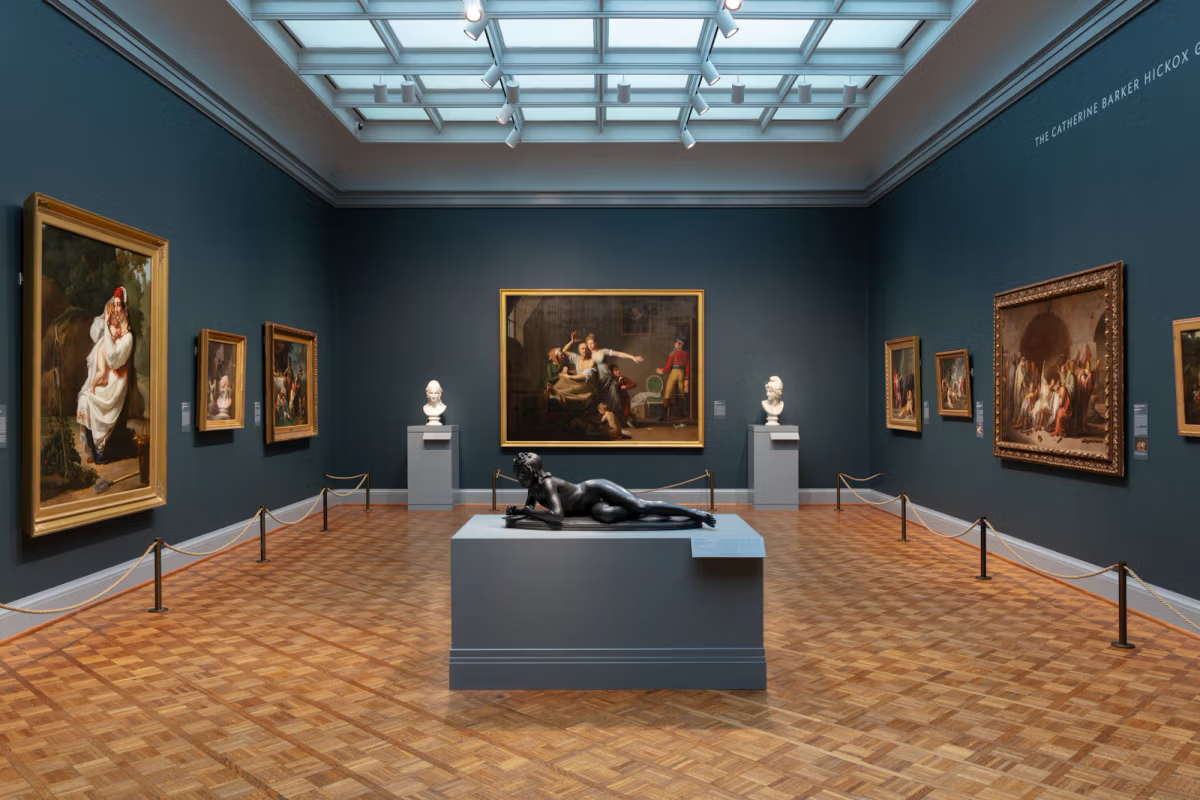
The Art Institute of Chicago, founded in 1879 and housed in its current Beaux-Arts building since 1893 — built for the World’s Columbian Exposition — is one of the oldest and largest art museums in the United States, with a permanent collection of around 300,000 works spanning five thousand years of human creativity across every continent. For most visitors, the first stop is the Impressionist and Post-Impressionist galleries on the second floor, where Georges Seurat’s monumental A Sunday on La Grande Jatte — 1884 occupies a room of its own and rewards a longer look than you’d expect any painting covered in dots to manage. Grant Wood’s American Gothic is here, as is Edward Hopper’s Nighthawks, that midnight diner scene so reproduced it has become a cliché and yet remains, in the original, genuinely moving. The Modern Wing, added in 2009 and designed by Renzo Piano with his characteristic light-filled intelligence, houses an excellent collection of twentieth-century and contemporary work. Allow at least half a day; the building is larger than it looks, and the temptation to wander is considerable.
Details:
- Location: 111 South Michigan Avenue, The Loop
- Website: artic.edu
- Hours: Thursday–Monday 11:00 AM–5:00 PM; closed Tuesday and Wednesday
- Fees: $25 (adult) / $19 (senior/student); children under 14 free; Chicago residents free on Thursday evenings
Tour Wrigley Field
Look, we know. It’s a baseball stadium. We are not particularly au fait with the finer points of Major League Baseball. But Wrigley Field is something else — a piece of American sporting history so atmospheric and so beautifully preserved that it would be worth visiting even if nobody ever played anything inside it. Built in 1914 as Weeghman Park, renamed Cubs Park in 1920 and finally Wrigley Field in 1926 after chewing-gum magnate William Wrigley Jr, it is the second-oldest Major League Baseball stadium still in use and the home of the Chicago Cubs, a team that managed to go 108 years between World Series victories (1908 to 2016) with a cheerfulness that Londoners of a certain persuasion will find deeply familiar. The hand-operated scoreboard in the centrefield wall dates from 1937 and is still updated manually during games by scoreboard operators working from inside. The ivy covering the outfield wall was planted in 1937, and any ball lodged in it during play is declared a ground-rule double. The guided tours, available on non-game days, take you through the press box, the clubhouses and out onto the field itself.
Details:
- Location: 1060 West Addison Street, Wrigleyville
- Website: mlb.com/cubs/ballpark/tours
- Hours: Tours available most non-game days; times vary, check the website
- Fees: From $35 (adult) / $20 (child under 12)

Browse the Chicago Riverwalk
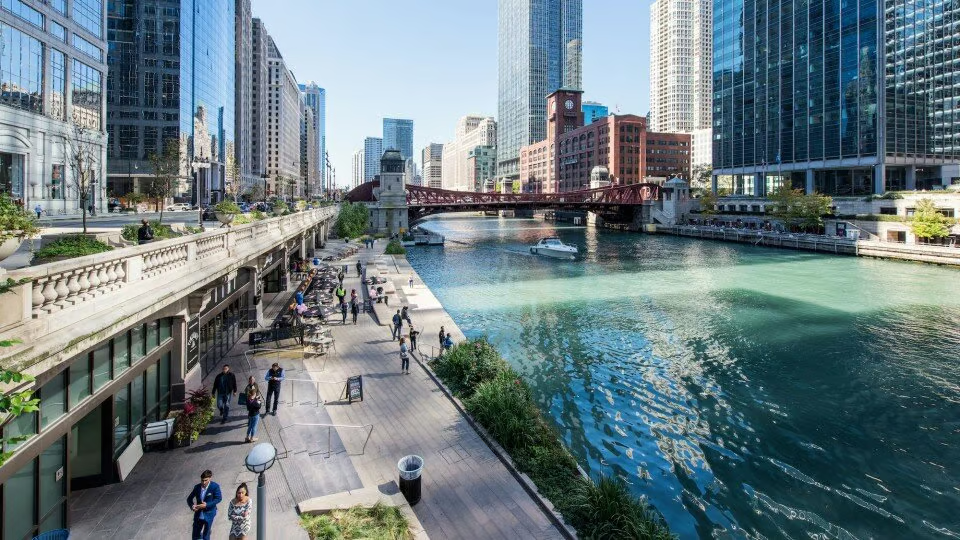
If St Lawrence Market is Toronto’s great outdoor food and leisure strip, Chicago’s equivalent is the Riverwalk — a 1.25-mile pedestrian promenade running along the south bank of the Chicago River from Lake Shore Drive to Lake Street, completed in its current form in 2016 after years of phased development. The Riverwalk passes through a series of distinct “rooms,” each with its own character: the Marina Plaza with its kayak and paddleboard rentals, the Cove for boats, the River Theatre, and a series of restaurant barges moored along the water. In summer the whole thing becomes a properly enjoyable outdoor destination in its own right, with live music, pop-up food stalls, boat tours departing every twenty minutes and views back up at the canyon of towers that makes the Chicago River so visually spectacular. It is particularly good in the evening, when the lights on the bridges and the facades of the buildings above reflect across the water, and when the architecture cruise crowd has thinned enough to find a quiet spot along the railing. We ate tacos on a barge. We had absolutely no regrets.
Details:
- Location: Along the south bank of the Chicago River, from Lake Shore Drive to Lake Street, The Loop
- Website: choosechicago.com/riverwalk
- Hours: Accessible at all times; most businesses open daily May–October, roughly 10:00 AM–10:00 PM
- Fees: Free to walk; individual vendors charge their own prices
Explore the Field Museum
The Field Museum occupies an enormous neoclassical building in Grant Park’s Museum Campus — a section of Chicago’s lakefront that also houses the Shedd Aquarium and the Adler Planetarium, and that on a clear day offers some of the best views of the skyline available from anywhere in the city. The museum was founded in 1893 to house the anthropological and natural history collections assembled for the World’s Columbian Exposition, that extraordinary Chicago event that introduced the world to the Ferris wheel, zipper, and Cracker Jack in the same summer. Today it contains more than 40 million specimens and objects across natural history, anthropology and geology. The undisputed star of the show is Sue, the largest and most complete Tyrannosaurus rex skeleton ever found, discovered in South Dakota in 1990 and acquired by the museum for $8.36 million at auction in 1997 — a sum that required a fundraising consortium including McDonald’s and Disney to put together. Sue now stands in the Griffin Halls of Evolving Planet with a level of personal charisma that we would not have thought possible in a 67-million-year-old skeleton, and the queues to photograph her suggest we are not the only ones who felt this way.
Details:
- Location: 1400 South Lake Shore Drive, Museum Campus
- Website: fieldmuseum.org
- Hours: Daily 9:00 AM–5:00 PM (last admission 4:00 PM)
- Fees: From $29 (adult) / $22 (child 3–11); under 3s free; Illinois residents receive discounted rates

Wander the Chicago Cultural Center
The Chicago Cultural Center is the kind of place we suspect half of the city’s visitors walk straight past without noticing, which is a fairly staggering oversight given that it contains two of the most beautiful interior spaces in the United States. Built in 1897 as the city’s central library and designed by the Boston firm Shepley, Rutan and Coolidge in a style that borrows liberally from the Venetian Renaissance, the Doge’s Palace and the Palazzo Ducale, the building features two enormous Tiffany glass domes — the largest surviving intact Tiffany glass dome in the world, the Preston Bradley Hall dome, measuring 38 feet in diameter — along with ornate marble mosaics, mother-of-pearl inlay and a grand staircase lined with Carrara marble. The gallery spaces host a rolling programme of free exhibitions, there is a wedding chapel in the dome room that is permanently booked years in advance, and the whole thing costs nothing to enter. We went in because it was raining. We stayed for forty-five minutes because it was extraordinary.
Details:
- Location: 78 East Washington Street, The Loop
- Website: chicagoculturalcenter.org
- Hours: Monday–Thursday 10:00 AM–7:00 PM; Friday–Saturday 10:00 AM–6:00 PM; Sunday 10:00 AM–6:00 PM
- Fees: Free

Spend a Day at the Griffin Museum of Science and Industry
The Griffin Museum of Science and Industry — known until 2024 as simply the Museum of Science and Industry, before a $125 million naming gift from hedge fund billionaire Ken Griffin — sits in Hyde Park in the only surviving building from the 1893 World’s Columbian Exposition. Originally the Fine Arts Palace, it opened as a public museum in 1933. We went in planning to spend a couple of hours and stayed for the better part of five. The headline act is the U-505, a German Type IXC submarine captured intact in the Atlantic in 1944 — the only German submarine taken at sea during the Second World War. The separate on-board tour takes you inside the vessel itself, which is every bit as claustrophobic and extraordinary as you’d hope.
Details:
- Location: 5700 South DuSable Lake Shore Drive, Hyde Park
- Website: griffinmsi.org
- Hours: Daily 9:30 AM–5:30 PM (select days vary; check website)
- Fees: General admission $25.95 (adult) / $14.95 (child 3–11); under 3s free. U-505 On-Board Tour $18 (adult) / $14 (child); Coal Mine $12 (adult) / $9 (child). CityPASS bundles entry with four other top Chicago attractions
- Getting there: No direct “L” stop; take CTA Bus 2 or 6, or Metra Electric from Millennium Station to 55th–56th–57th Street (roughly 2 blocks from the museum)

Discover the Shedd Aquarium
The John G. Shedd Aquarium opened on the Museum Campus in 1930, named for a Marshall Field’s department store magnate who donated $3 million to get it built and never lived to see it open. It draws well over two million visitors a year, and the interior delivers a genuinely excellent few hours at any age. The Caribbean Coral Reef centrepiece tank holds 90,000 gallons of water and more than 500 fish, sharks, rays and sea turtles. The Abbott Oceanarium houses Pacific white-sided dolphins and beluga whales, with daily presentations by the animal care team. A new 4D Immersion Theatre opened in spring 2026. Book ahead — it gets busy at weekends.
Details:
- Location: 1200 South Lake Shore Drive, Museum Campus
- Website: sheddaquarium.org
- Hours: Daily 9:00 AM–6:00 PM (extended to 7:00 PM on select days; check website)
- Fees: General admission prices vary with plan-ahead pricing — book online in advance for the best rates; standard adult tickets from around $39.95; Chicago residents $19.95 (adult) / $14.95 (child 3–11); under 3s free. CityPASS includes All-Access Admission
- Getting there: CTA Bus 146 from Michigan Avenue; Museum Campus–11th Street stop on the Metra Electric line; water taxi from the Riverwalk (seasonal)

Spend a Morning at Lincoln Park Zoo
Lincoln Park Zoo takes you by surprise even when you know perfectly well what you’re walking into. Founded in 1868 — one of the oldest zoos in North America, established when Chicago was barely a generation old — it covers 49 acres of Lincoln Park and remains one of the only entirely free-admission zoos in the United States. More than 170 species are resident, with highlights including the Regenstein Center for African Apes, where gorillas and chimpanzees are visible at genuinely close quarters, the magnificent 1912 Kovler Lion House, and the Pritzker Family Children’s Zoo. The December ZooLights installation, covering the entire site in half a million lights, is one of the great free seasonal events in the city.
Details:
- Location: 2400 North Cannon Drive, Lincoln Park
- Website: lpzoo.org
- Hours: Daily 10:00 AM–5:00 PM (weekends and holidays 10:00 AM–6:30 PM in summer; hours vary seasonally — check the website)
- Fees: Free admission, 365 days a year. Paid parking available on Cannon Drive
- Getting there: CTA Buses 151 or 156 from Michigan Avenue; roughly 20 minutes from the Loop

Visit Navy Pier
We had been told by more than one person that Navy Pier was a tourist trap and that only visitors went there. We went anyway, on the basis that most places described as tourist traps are described that way by locals who haven’t been in fifteen years and have forgotten why tourists go in the first place. The pier opened in 1916, served as a naval training station during both world wars, and was reinvented as a public entertainment destination in 1995. It packs a Ferris wheel, the Chicago Shakespeare Theater, the Crystal Gardens conservatory, restaurants, boat tours and free Wednesday and Saturday evening fireworks over the lake into a very satisfying half mile of lakefront.
Details:
- Location: 600 East Grand Avenue, Streeterville
- Website: navypier.org
- Hours: Monday–Thursday 10:00 AM–10:00 PM; Friday–Saturday 10:00 AM–midnight; Sunday 10:00 AM–10:00 PM (hours vary seasonally — check the website)
- Fees: Free to enter; Ferris wheel from $18 (adult) / $15 (child); Chicago Shakespeare Theater tickets vary by production; fireworks free Wednesday and Saturday evenings in summer
- Getting there: CTA Buses 29, 65 or 66 from Michigan Avenue; water taxi from the Riverwalk (seasonal); roughly a 20-minute walk from Millennium Park along the lakefront

Getting to and Around Chicago
Getting to Chicago
By Air: Chicago is served by two international airports. O’Hare International Airport (ORD) is one of the busiest airports in the world — it handled more than 80 million passengers annually before the pandemic and has been in a state of significant expansion and renovation since 2018 — and remains the primary gateway for transatlantic and transcontinental flights. Midway Airport (MDW) is smaller, closer to the city centre and served primarily by Southwest Airlines; if you’re travelling domestically and Midway works for your routing, it’s a notably less stressful experience than O’Hare.
By Train: Chicago’s Union Station is Amtrak’s busiest hub outside the north-east corridor. Direct intercity rail services connect Chicago with Milwaukee (1 hour 30 minutes), St. Louis (around 5 hours), Detroit (around 5 hours 30 minutes) and Minneapolis (around 8 hours), among others. The overnight California Zephyr to San Francisco and the Lake Shore Limited to New York both depart from Union Station, for anyone with the time and inclination for a proper rail journey.
By Road: Greyhound, FlixBus and Megabus all run coach services into Chicago from cities across the Midwest and beyond. Driving into the city is straightforward via the interstate network, but parking downtown is expensive and the traffic on the expressways during rush hour is legendary in the worst possible sense.
Getting Around
The “L” Train: The CTA’s elevated (and partly underground) rail network runs eight colour-coded lines across the city and is by some distance the most efficient way to get around. The Red and Blue lines run 24 hours a day; the other six lines run from roughly 4:00 AM to 1:30 AM. Fares are $2.75 per ride with a Ventra card (which can be loaded via the Ventra app), and a one-day unlimited pass costs $5 — worth it if you’ll make more than two journeys. The Blue Line connects O’Hare to the Loop in around 40 minutes for $5 (an airport surcharge applies departing from O’Hare); the Orange Line connects Midway in around 25 minutes at the standard $2.75.
- Website: transitchicago.com
- Fare: $2.75 per ride; day pass $5; 3-day pass $20; 7-day pass $30
CTA Bus: More than 130 bus routes cover the parts of the city the “L” doesn’t reach directly, at $2.50 per ride with Ventra. The same Ventra card works across both trains and buses.
Divvy Bikes: Chicago’s bike-share scheme covers around 950 stations and 17,000 bikes across the city, including e-bikes. Single rides cost $1 to unlock plus $0.20 per minute; a day pass costs $15 for unlimited 3-hour rides. The 18-mile Lakefront Trail along Lake Michigan is one of the great urban cycling routes in the country.
- Website: divvybikes.com
Taxis and Rideshare: Uber and Lyft both operate widely across the city. A taxi from O’Hare to downtown costs around $45; from Midway, around $35.
Driving: Useful for day trips outside the city, but genuinely unnecessary within it, and downtown parking will set you back $35–50 per day at the cheaper garages.
Vegan Dining in Chicago
🥗 The Chicago Diner
Chicago’s most beloved and longest-running vegan institution has been operating on North Clark Street in Lakeview since 1983 — hence the tagline “Meat Free Since ’83,” which is not a boast so much as a statement of fact — and it remains the first port of call for plant-based visitors to the city. The menu is the kind of comforting, crowd-pleasing roster that could convert the unconvinced: a properly built Radical Reuben, a diner burger with vegan cheese that arrives thick and charred, milkshakes, malts and a raspberry mocha cheesecake that has its own devoted following. This is American diner food done entirely without animal products, and done very well.
- Location: 3411 North Clark Street, Lakeview
- Hours: Monday–Friday 11:00 AM–10:00 PM; Saturday–Sunday 10:00 AM–10:00 PM
- Website: veggiediner.com
🍜 PLANTA Queen
Chicago’s swankiest vegan restaurant occupies a handsome space in River North and has quickly established itself as the city’s go-to for plant-based fine dining with a distinctly Asian bent. Executive Chef David Lee’s menu covers crispy gyoza, sushi rolls, udon with truffle mushroom cream and wok-tossed specialities, all genuinely excellent, alongside cocktails creative enough to justify a second visit purely for the bar programme. Lively, confident and very good — also 100% vegan, which it wears rather lightly.
- Location: 413 North Clark Street, River North
- Hours: Monday–Thursday 11:30 AM–10:00 PM; Friday 11:30 AM–11:00 PM; Saturday 10:30 AM–11:00 PM; Sunday 10:30 AM–10:00 PM
- Website: plantarestaurants.com/location/planta-chicago
🍺 Handlebar
Handlebar has been serving made-from-scratch vegetarian and vegan comfort food in Wicker Park since 2003, and its combination of fried avocado tacos, sambal tofu, vegan chilli mac and a beer garden busy enough on a summer evening that you’ll need to arrive early has earned it a cast of fiercely loyal regulars. It’s casual, loud, good value and genuinely fun — particularly when the weather is warm enough for the garden. No reservations, so be prepared to queue on weekends.
- Location: 2311 West North Avenue, Wicker Park
- Hours: Monday–Friday 11:00 AM–2:00 AM; Saturday 10:00 AM–3:00 AM; Sunday 10:00 AM–2:00 AM
- Website: handlebarchicago.com
🌮 Penelope’s Vegan Taqueria
Chicago’s first fully plant-based taqueria operates on the North Side and delivers exactly what the name promises: vibrant, street-style Mexican food using entirely plant-based proteins, with a rotating roster of vegan tacos, Mexican beers and cocktails that have made it one of the most talked-about additions to Chicago’s vegan scene. The atmosphere is appropriately colourful and lively, and the food is the kind that makes you forget you’re asking where the meat is.
- Location: 2452 North Clark Street, Lincoln Park
- Hours: Tuesday–Sunday 11:00 AM–9:00 PM; closed Mondays
- Website: penelopeschicago.com
🍔 Soul Veg City
Soul food, in its Chicago incarnation, is a tradition that runs deep on the South Side, and Soul Veg City — part of a small chain with roots in the African Hebrew Israelite community, which has been promoting plant-based eating since the 1970s — brings that tradition to the table in entirely vegan form. The menu covers mac and cheese, BBQ riblets, collard greens, cornbread and other comfort-food staples, all prepared without animal products and without any sense of deprivation. A genuinely singular place, and one that puts the lie to any notion that vegan food is a recent or exclusively middle-class phenomenon.
Location: 203 East 75th Street, Grand Crossing (South Side)
Hours: Daily 11:00 AM–9:00 PM (check website for current times)
Website: soulvegcity.com
The Best Time to Visit Chicago
December to February — Winter
Chicago in winter is serious business. The wind off Lake Michigan — the so-called “Hawk” in local parlance — has a particular quality that seems to find its way through every layer you’ve brought, and temperatures can plunge well below -10°C with a wind chill that the National Weather Service issues advisories about. None of which should necessarily put you off: the German-inspired Christkindlmarket in Daley Plaza, running from late November through December, is one of the best Christmas markets in the United States, with mulled wine, bratwurst and hand-crafted gifts set against a backdrop of the Loop’s architecture and fairy lights. Hotel rates outside the holiday fortnight are the lowest of the year, and the city’s museums, restaurants, jazz clubs and comedy venues are entirely indifferent to the weather outside.
Packing: Properly insulated winter coat, thermal base layers, waterproof boots rated to at least -20°C, gloves, wool hat, scarf and hand warmers. This is not the time for a fashion-forward approach to cold weather.
March to May — Spring
Spring arrives late and argues about it until roughly mid-May, when Chicago remembers it is not February any more and allows temperatures to climb into something approximating pleasant. March and April can deliver 20°C warmth one week and snow the next, so packing in layers is non-negotiable. The city shakes off winter with considerable enthusiasm: the Chicago Cubs home opener at Wrigley Field in April is a genuine occasion, Lincoln Park blooms with magnolias and cherry trees, and the Riverwalk reopens its restaurant barges to a city that has been waiting patiently since October. Prices and crowds are noticeably lower than summer, and May is, by widespread agreement, one of the two best months to visit the city.
Packing: A waterproof jacket you can rely on, a mid-weight coat for evenings, layers, comfortable walking shoes and the psychological flexibility to deal with a thirty-degree temperature swing in the space of a single week.
June to August — Summer
This is Chicago at its most alive: long evenings, lakefront beaches genuinely worth swimming at (Lake Michigan doesn’t get properly warm until July, but when it does it’s lovely), and a festival calendar so packed it requires advance planning to navigate. Lollapalooza takes over Grant Park for four days in early August. The Chicago Blues Festival in June and the Chicago Jazz Festival in September bracket the summer with music that goes back to the city’s roots as a destination for the Great Migration, when African Americans arrived from the South in their hundreds of thousands in the early twentieth century and brought with them musical traditions that would transform American culture. Navy Pier fires off free fireworks on Wednesday and Saturday evenings throughout the summer. The whole city moves outside.
Packing: Lightweight, breathable clothing, swimwear for the lake beaches, sunscreen, sunglasses and a refillable water bottle — Chicago summers are humid, and staying hydrated is serious advice rather than just a formality.
September to November — Autumn
Autumn in Chicago is, frankly, gorgeous: crisp air, golden light, the trees in Lincoln Park and Grant Park turning properly spectacular, and a city that has recovered from the summer exhaustion and is back to its civilised, unhurried self. The Chicago Marathon in October draws more than 45,000 runners through all 77 of the city’s neighbourhoods, and Open House Chicago in October gives the public access to hundreds of buildings normally closed to visitors, which in a city this architecturally significant is not a small thing. Hotel rates ease considerably from the summer peak, and the weather often stays pleasant well into October.
Packing: A mid-weight jacket and layers for unpredictable daytime temperatures, a compact umbrella, comfortable shoes for walking and an eye on the forecast as November approaches.
Overall Best Time
June to September offers the fullest experience of Chicago’s outdoor life, festivals and lakefront, though it comes with the highest prices and biggest crowds. For the best combination of decent weather, manageable crowds and reasonable hotel rates, May and September are the sweet spot that most people who’ve visited in every season tend to recommend.

Where to Stay in Chicago?
The Loop and the Riverwalk
Chicago’s commercial and architectural core: the “L” train runs directly overhead (it’s worth knowing that the Loop gets its name from the elevated railway that circles the downtown blocks), with Millennium Park, the Art Institute, the Riverwalk and most of the city’s major attractions within easy walking distance. The liveliest base for a first visit, and the most straightforwardly convenient.
Hotels:
- The Fairmont Chicago at Millennium Park (⭐⭐⭐⭐⭐) — Grand lakefront luxury hotel directly overlooking Millennium Park and Cloud Gate, with a full spa and an excellent location for the Art Institute, the Riverwalk and the “L.”
- The Palmer House, A Hilton Hotel (⭐⭐⭐⭐) — One of the great American railway-era hotels, in continuous operation since 1875 and featuring a lobby of genuinely extraordinary Beaux-Arts splendour that alone is worth a look.
- HI Chicago — The J. Ira and Nicki Harris Family Hostel — Chicago’s best-known budget option, sociable and well located in the heart of the Loop, with private rooms available alongside dormitories.
The Magnificent Mile and Gold Coast
The eight-block stretch of North Michigan Avenue known as the Magnificent Mile has been the address of choice for luxury hotels since the 1920s, and the Gold Coast immediately north of it continues the tradition in quieter, more residential style. Both neighbourhoods put you within easy reach of the lake, Navy Pier and the North Side.
Hotels:
- The Waldorf Astoria Chicago (⭐⭐⭐⭐⭐) — Elegantly appointed luxury hotel in the Gold Coast, with a celebrated spa and some of the finest rooms in the city, catering squarely to visitors who consider service a non-negotiable.
- The InterContinental Chicago Magnificent Mile (⭐⭐⭐⭐) — Historic landmark hotel in a 1929 Medinah Athletic Club building on Michigan Avenue, with original Spanish-Moorish architecture including a magnificent indoor swimming pool on the fourteenth floor.
- Aloft Chicago Mag Mile (⭐⭐⭐) — A three-star Marriott property built on the former site of the Museum of Contemporary Art, one block from the Magnificent Mile, with a heated indoor pool, a lively W XYZ Bar and clean, modern rooms with LEED sustainability certification. Rates run roughly $130–160 a night in peak season and considerably less off-peak, making it one of the better-value options on this stretch of the city by some margin. Dogs welcome, which is always a good sign in our experience.
River North
Chicago’s gallery district, turned restaurant and nightlife hub over the past three decades, sits just north of the river and puts you walking distance from the Riverwalk, the architecture cruise departure point and the Magnificent Mile. Livelier than the Loop at night, and well served by the “L.”
Hotels:
- The Langham, Chicago (⭐⭐⭐⭐⭐) — Occupying the lower floors of the IBM Building, the last skyscraper designed by Mies van der Rohe and completed in 1973, The Langham is widely regarded as the finest hotel in Chicago — the Chuan Spa, a 67-foot indoor pool, Alaskan white marble bathrooms with deep soaking tubs and floor-to-ceiling views over the Chicago River put it in a different league altogether. Consistently rated exceptional by guests, and the afternoon tea at the Pavilion lounge is a rather civilised way to spend an hour between sightseeing.
- ACME Hotel Chicago (⭐⭐⭐) — A rock-and-roll boutique three-star two blocks from the Magnificent Mile, with an Amazon Alexa in every room, an album-cover-lined lift, a guitar available to borrow at the front desk and the excellent Berkshire Room cocktail bar downstairs. Voted number one hotel in Chicago by Condé Nast Traveler readers in 2019 and consistently in the top ten since, which is quite an achievement for a hotel that doesn’t take itself remotely seriously. Well-priced for the location, and considerably more fun than a chain.
- Freehand Chicago — A design-forward hostel-hotel hybrid in a beautifully restored 1927 Art Deco building in River North, offering both dormitory beds and private rooms at prices that feel genuinely reasonable for the neighbourhood. The Broken Shaker bar downstairs — a Condé Nast Traveler award-winner in its own right — serves some of the best craft cocktails in the city, and Café Integral does exceptional Nicaraguan coffee for breakfast. The kind of place that makes budget travel feel like a deliberate lifestyle choice rather than a compromise.
Wicker Park and Bucktown
- The Robey Chicago (⭐⭐⭐⭐) — Beautifully converted 1929 Art Deco tower in the heart of Wicker Park, with a celebrated rooftop bar, a ground-floor restaurant and a design-led aesthetic that makes it one of the most characterful hotels in the city. It is the premium option in the neighbourhood and deservedly so — there is no 5-star hotel in Wicker Park, and frankly The Robey is better for it.
- Ray’s Bucktown Bed and Breakfast (⭐⭐⭐) — Eleven rooms in a European-style B&B tucked into a quiet residential street in Bucktown, rated the number-one B&B in Chicago on Booking.com and it is not hard to see why. The cooked-to-order breakfast — eggs your way, French toast, roasted red potatoes — is included in the rate, free parking is available, the sauna and steam room are a nice touch, there’s a rooftop garden, and the owners have clearly put genuine thought into making the place feel like somewhere rather than just somewhere to sleep. It’s dog-friendly, LGBTQ-friendly and thoroughly unpretentious in the best possible way. Book direct via their website if you can, as they’ll price-match any rate you find elsewhere.
- Stay 424 Hostel — A hostel with genuine neighbourhood character, sitting right in the thick of Wicker Park at 1415 North Ashland Avenue, with dorm beds, private rooms, a coworking space, an on-site restaurant serving Mexican food, a rooftop deck and the kind of sociable, creative atmosphere that fits the surrounding neighbourhood rather well. Dorms from around $34 a night; the best-value option in Wicker Park by a considerable distance.
Related
1 2
More to Explore


Shedd Aquarium is a world-renowned freshwater and marine aquarium located on Chicago's stunning Museum Campus offering immersive exhibits interactive encounters and awe-inspiring marine life displays that captivate millions of visitors from around the globe every year.