


The Edzná archaeological site, nestled in the Mexican state of Campeche, is a fascinating and historically rich complex that showcases the architectural ingenuity and ceremonial significance of the ancient Maya civilisation, with its impressive five-storey pyramid, sophisticated canal system for water management, and a variety of well-preserved structures that reflect the socio-political and religious complexities of a once-thriving urban centre.
Mexico: Quintana Roo – Xcaret Eco-Archeological Park
🌊 A Park Born from the Sea and the Jungle
Nestled along the turquoise shores of the Riviera Maya in Quintana Roo, Mexico, Xcaret Eco-Archaeological Park spans over 40 hectares of pristine tropical landscape that has been thoughtfully developed to celebrate the natural and cultural heritage of the Yucatán Peninsula. Opened in 1990, the park was conceived as far more than a theme park — it is a living tribute to Mexico’s extraordinary biodiversity and its ancient Mayan civilisation. Visitors arrive to find a remarkable environment shaped by cenotes, underground rivers, and coastal inlets that have been carefully preserved and integrated into the park’s design. The result is an immersive setting that feels both wild and welcoming, where the rhythms of nature set the pace of each visit. Whether arriving by shuttle from nearby Cancún or Playa del Carmen, guests are greeted by a sense of discovery that lingers long after departure. The park operates as a full-day destination, and most guests find that a single day barely scratches the surface of everything on offer.
We didn’t see or try everything by any means but here are some of the highlights for us.
1. Find our about MEXICO’S WILDLIFE
2. Enjoy the water activities, including the SWIMMING LAGOON, SEA LIFE AND BOAT TOURS
3. Float or swim along Xcaret’s UNDERGROUND RIVERS
4. Explore the ST. FRANCIS OF ASSISI CHAPEL & THE “BRIDGE TO PARADISE” CEMETERY
5. Learn about Mayan culture at the MAYAN VILLAGE
6. Check out the CHAPEL OF OUR LADY OF GUADALUPE
7. Enjoy the MEXICAN RODEO / LA CHARRERÍA whilst eating at La Cocina restaurant
8. Finish your day at Xcaret at the MÉXICO ESPECTACULA
🦜 Mexico’s Wildlife
We found ourselves wandering through what felt like a proper jungle — hot, humid, and alive with noise in the way that only somewhere genuinely tropical can be. Xcaret sits on the Caribbean coast of Quintana Roo, a state in the south-east of Mexico that only became a proper federal entity as recently as 1974. Before that it was little more than a sparsely populated territory, largely because the ancient Maya had been there first and the Spanish conquistadors had found the whole dense jungle business rather off-putting when they arrived in the 16th century. Can’t say I blame them.
The wildlife on display was the sort that reminds you just how far from Wolverhampton you actually are. Scarlet macaws — Ara macao — swooped about in pairs, as they tend to do in the wild, being monogamous creatures that mate for life. The Maya considered them sacred, associated with the sun god Kinich Ahau, and used their vivid red and yellow feathers in ceremonial headdresses. Today they’re endangered across much of their original range, which once stretched from southern Mexico all the way down through Central America to Brazil. Seeing them here felt oddly moving, even for someone who isn’t normally given to being moved by birds.
The flamingos were doing what flamingos do — standing about on one leg looking faintly absurd and a rather impressive shade of pink. The colour, as any dinner party bore will tell you, comes entirely from the carotenoid pigments in the algae and crustaceans they eat. Feed them plain food and they go white. Much like the English on holiday, really.
Then there were the jaguars. The jaguar — Panthera onca — was the apex predator of the ancient Maya world, and no creature held greater symbolic weight in Mesoamerican culture. The Maya jaguar god Ix Chel was associated with the night, the underworld, and shamanic power. Rulers wore jaguar pelts. Warriors took jaguar names. The animal was, in short, a Very Big Deal. Today, jaguars have been pushed out of around 40% of their historic range and are classified as Near Threatened by the IUCN. Spotting one, even in a park setting, felt like a reminder of what the region once was — dense, wild, and utterly indifferent to human ambition.
Between the animals, we stumbled across several Mayan ruins dotted around the site. Xcaret itself was once a pre-Columbian port town known as Polé, which served as an embarkation point for Maya pilgrims making the short sea crossing to the sacred island of Cozumel to worship Ix Chel, goddess of the moon and medicine. The ruins here date from roughly 900 to 1500 AD — the Late and Terminal Classic periods — and include small temples and ceremonial platforms that once would have bustled with religious activity. Now they bustle with tourists in sun hats, which is a different kind of ceremony altogether.


🏖️ Beachfront: Swimming Lagoon, Sea Life and Boat Tours
Xcaret does a pretty thorough job of covering every possible thing you might want to do with water, and we set off to find out just how thorough.
Our first stop was the dolphin enclosures — a series of large pens right there on the waterfront where, for a not-insignificant sum of money, you can splash about with a bottlenose dolphin and feel briefly like a marine biologist. The bottlenose dolphin (Tursiops truncatus, since you ask) has been kept in captivity for entertainment purposes since the 1930s, and the practice has never stopped being controversial. These are, by any measure, extraordinarily intelligent animals — capable of complex communication, problem-solving, and what researchers have called self-awareness. So watching them perform their obligatory tricks for tourists was, we’ll be honest, a bit dispiriting. We love these creatures. Seeing them in pens the size of a modest municipal swimming pool was not our finest hour as a species.
Nearby, there were further enclosures housing alligators — specifically the American crocodile (Crocodylus acutus), which is native to this part of coastal Mexico and was once hunted almost to extinction along the Yucatán coastline — along with manatees, the wonderfully absurd-looking sea cows that Columbus famously mistook for mermaids in 1493, which tells you quite a lot about the quality of the women Columbus had been spending time with.
Past the animal exhibits, the park opened out onto a proper marina and a genuinely pleasant family beach area. The whole beachfront here sits along the Caribbean coast of Quintana Roo, a stretch of shoreline that has been drawing visitors since the Mexican government essentially invented the resort town of Cancún from scratch in the early 1970s. Before that, this entire coastline was largely coconut plantation and jungle. Now, of course, it’s one of the busiest tourist corridors on the planet, so swings and roundabouts.
We had signed up for a snorkel boat tour, which departed from the far end of the marina. On the way down the dock, we passed the sea turtle breeding programme — large shallow ponds containing what appeared to be several hundred baby turtles of varying sizes, from ones barely bigger than a biscuit to juveniles the size of a dinner plate. The green sea turtle (Chelonia mydas) was once heavily exploited along this coast for its meat, eggs, and shell, and populations collapsed dramatically through the 20th century. Xcaret has been running its turtle breeding and release programme since the early 1990s, returning hatchlings to the wild as part of broader conservation efforts across the region. It was, genuinely, quite moving to see — though one does slightly question the optics of charging admission to watch conservation work happening in between dolphin rides and souvenir shops.
Beyond the hatchling ponds, there was a large open-water enclosure where fully grown sea turtles glided through the green shadows beneath the walkways and mangrove roots — ancient, unhurried, and entirely unbothered by the humans craning over the railings above them. Mangroves, incidentally, are remarkable things: the red mangrove (Rhizophora mangle) that lines much of this coast provides nursery habitat for much of the marine life in the Caribbean, and the Yucatán peninsula has some of the most extensive mangrove systems left in Mexico. Worth knowing, even if it is the sort of fact that doesn’t get you invited to many parties.
The snorkel tour itself lasted roughly two hours and took us along the shoreline just outside the park’s harbour. Now, a word of honest expectation management: if you’ve snorkelled anywhere around Cozumel — which lies about 70 kilometres to the northeast and sits above one of the most impressive reef systems in the entire Caribbean — the reefs here will feel a little underwhelming by comparison. Cozumel’s reefs form part of the Mesoamerican Barrier Reef, the second longest in the world after the Great Barrier Reef, and they are spectacular. What we found here was, let’s say, more modest — some coral, some rocks, a few solitary fish going about their business with the quiet dignity of commuters who’ve missed the last bus.
That said, we did have one genuinely thrilling wildlife encounter. A sea turtle — apparently unaware of or deeply indifferent to the convention that wild animals are supposed to be shy — swam directly up to us, looked us square in the face mask, and we thought: how lovely, how charming, what a delightful and friendly creature.
Then the little sod bit our finger.
Not hard enough to draw blood, thankfully, but hard enough to make the point. We’ve been back on land for three days now and we’re still slightly offended. If we ever see that particular turtle again, he’s going in a stew.


🌊 Underground Rivers
We pulled on our life jackets, adjusted our goggles, and shuffled nervously toward the water. What followed was, without doubt, one of the more memorable hours of the entire trip — and I say that as someone whose idea of adventure normally involves a difficult car park.
Xcaret sits on the Caribbean coast of the Yucatán Peninsula, in the Mexican state of Quintana Roo. The whole region is built on a vast slab of porous limestone — the kind of rock that, over millions of years, has been slowly dissolved by rainwater seeping through it, carving out an extraordinary network of underground tunnels, caves, and caverns. The Maya, who had been living here for well over two thousand years before the Spanish arrived in the early sixteenth century, knew all about these underground waterways. They called them cenotes — sacred openings to the underworld, used for ceremony, for fresh water, and, on particularly bad days for certain unfortunate souls, for sacrifice. Cheerful lot.
At Xcaret, that ancient geology has been turned into something rather wonderful. There are three underground rivers to choose from: the Blue River, the Mayan River, and the Manatee River. All three eventually emerge into daylight and flow out to sea beside mangroves — beautiful, tangled stretches of coastal forest that are home to colonies of pink flamingos. Yes, actual flamingos. Standing there looking absurd and magnificent, as flamingos tend to do.
We chose one of the rivers, stepped in, and let the current do the work. The water was crystal clear — and cold enough to make you say something you probably shouldn’t in front of the children. As you drift along, the tunnel closes in around you and the light changes completely. Natural air vents punctuate the cave ceiling above, letting shafts of light drop into the darkness in a way that is, frankly, rather beautiful and almost worth the wet ears.
What surprised us most were the cave walls themselves. Pressed into the rock — preserved there for millions of years — were fossilised coral formations. Actual coral. Up here on dry land, or rather under it. This is because the whole Yucatán Peninsula was once submerged beneath a shallow tropical sea, long before humans, the Maya, or anyone else turned up. What you are floating past is, in effect, a fossilised reef. It puts things in a certain perspective.
The whole experience lasted about half an hour per river and required absolutely no skill whatsoever, which suited us perfectly. You simply float. The current does the rest. Even I managed it without incident, which was not guaranteed.
⛪ St. Francis of Assisi Chapel and the “Bridge to Paradise” Cemetery
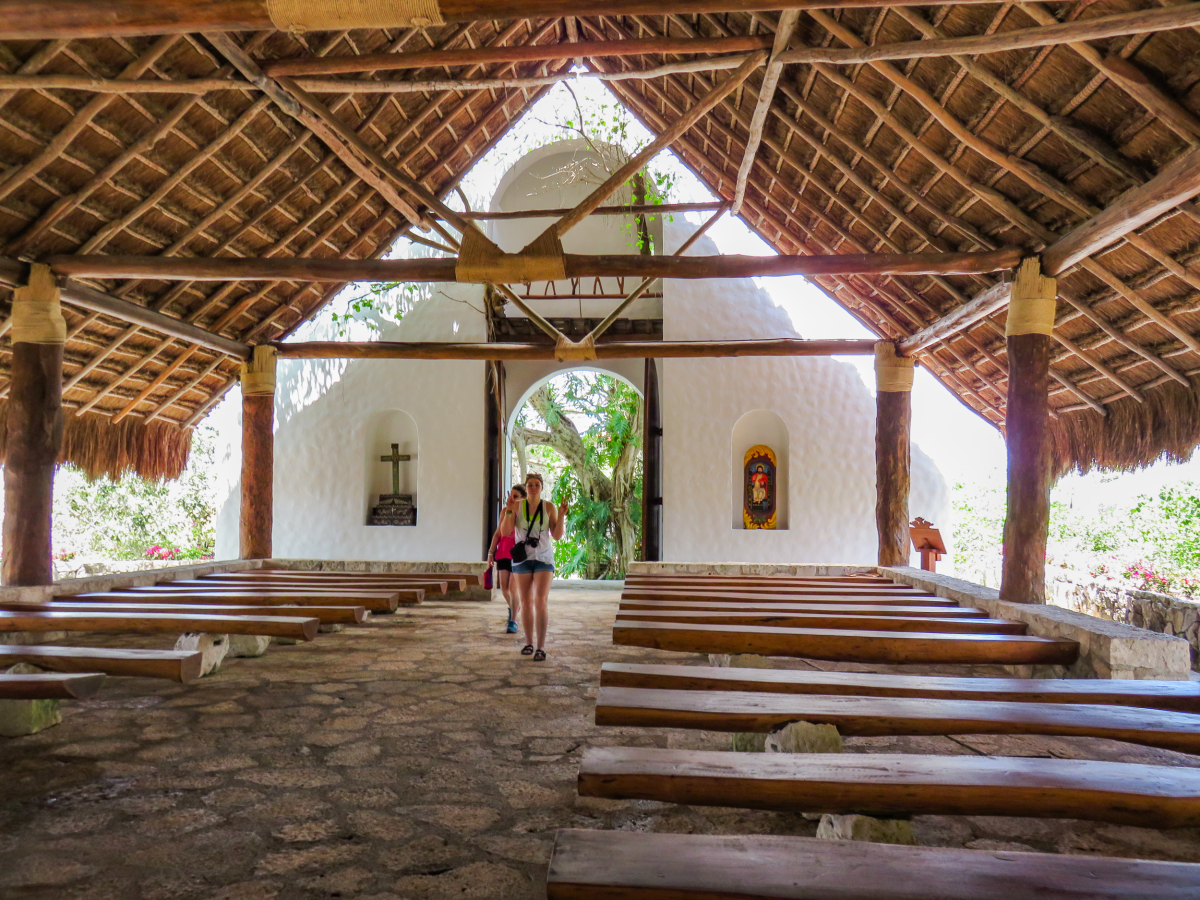
We made our way up to the highest point in the park — all 37 metres (about 121 feet) of it, which doesn’t sound much until you’re actually climbing it in the Mexican heat and quietly regretting every life choice that led you there — and found ourselves at the Chapel of St. Francis of Assisi.
St. Francis, as most of us half-remember from school, was the 13th-century Italian friar born in Assisi in 1181 or 1182 who became famous for his deep bond with the natural world. He reportedly preached to birds, negotiated with a wolf, and generally got on better with animals than most people manage with other people. He was canonised by Pope Gregory IX in 1228, just two years after his death, and has been the patron saint of animals and the natural environment ever since. It’s fitting, then, that his chapel sits up here amid the trees of the Yucatán, which have been doing their thing rather well for millennia without any of our help.
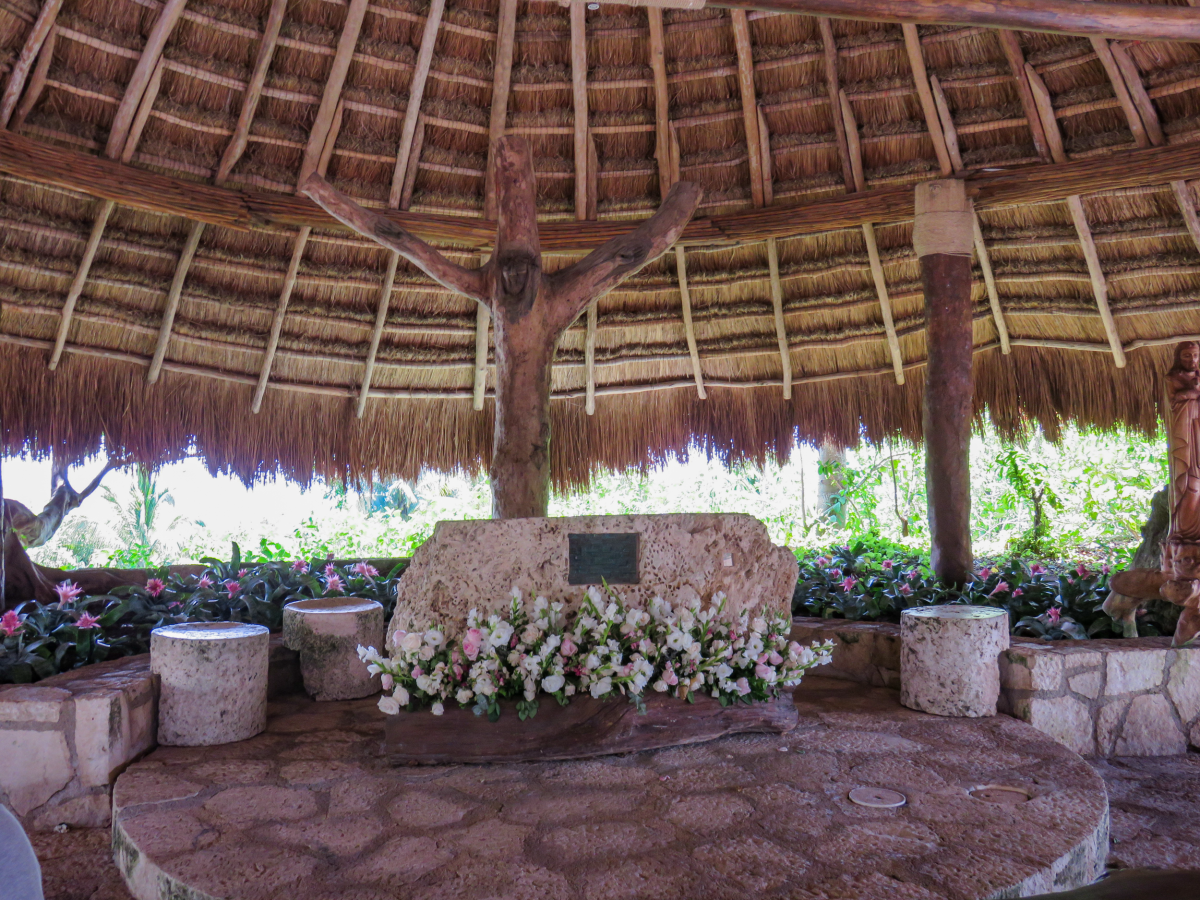
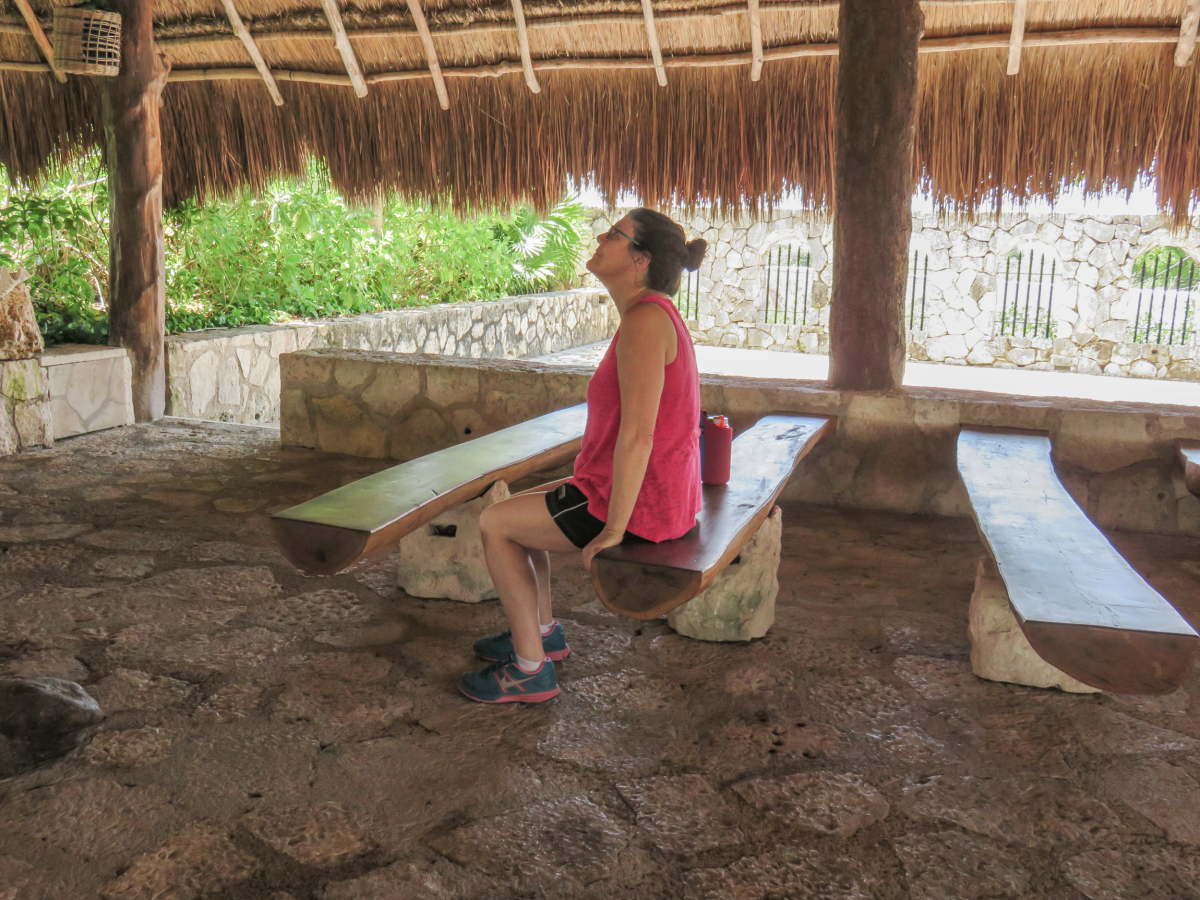
The chapel itself was built with a quiet intelligence. Rather than bulldozing everything and starting fresh — the default approach, it seems, for most human construction projects — the designers worked with what was already there. There’s a living tree incorporated right at the entrance, a cross carved into a chicozapote tree (a tropical hardwood the ancient Maya used extensively, and which produces chicle, the original ingredient in chewing gum — a fun fact that feels oddly out of place in a chapel), a limestone altar, and pews made from salam wood. The whole thing felt genuinely peaceful rather than performatively so, which is rarer than it should be.
We sat for a few minutes in the kind of silence that actually works. No small achievement.
Then we turned around and spotted the cemetery, and silence promptly went out of the window.
The “Bridge to Paradise” Mexican cemetery sat in the near distance looking, frankly, spectacular — all bold colour and architectural drama against the jungle backdrop. Mexican cemetery culture has its roots going back well before the Spanish arrived in the early 16th century. The Aztecs and Maya both held elaborate rituals for the dead, believing in layered underworlds and the importance of guiding souls safely into the next life. When Catholicism arrived with the conquistadors from around 1519 onwards, it didn’t so much replace these beliefs as collide with them rather noisily, eventually producing the extraordinary tradition of Día de los Muertos — the Day of the Dead — which the UNESCO actually added to its Intangible Cultural Heritage list in 2008. This cemetery is a physical expression of all of that: pre-Hispanic tradition, colonial Catholicism, Mexican folk art, and a considerable amount of sheer visual confidence, all stacked together.
Look at the shape of the place and you’d be forgiven for missing it at first — but it’s built in the form of a spiral shell, specifically a conch. The ancient Maya blew into conch shells as a way of communicating with their gods, using them in ceremonies and rituals across Mesoamerica for thousands of years. Finding one here, rendered in stone and tile, felt like exactly the right kind of detail.
The numbers embedded in the design are worth paying attention to. The cemetery has seven levels, standing for the seven days of the week. It has 52 steps, one for each week in the year. And it contains 365 tombs — one for every day of the year. The Maya, it’s worth noting, were obsessive and brilliant calendrical mathematicians; their Long Count calendar tracked cycles of time stretching back to what they calculated as the dawn of the current world in 3114 BC. The fact that someone decided to embed that same numerical precision into a cemetery in a theme park on the Caribbean coast of Mexico in the modern era felt, unexpectedly, rather moving.
We stood there longer than we probably should have. But then, that’s rather the point of a place like this.


🏛️ The Mayan Village
We wandered into the Mayan village section and, honestly, it was one of those rare moments where you actually stop faffing about with your phone and pay attention.
What you’re walking through is a carefully reconstructed pre-Hispanic community — the kind of settlement that would have been dotted across the Yucatán Peninsula long before anyone from Europe had the bright idea of sailing west and making a mess of things. The Maya were building sophisticated urban societies here from as far back as 2000 BC, and by the Classic Period — roughly 250 to 900 AD — they had cities, astronomy, a written language, and a grasp of mathematics that most of us would struggle with on a good day. Then the Spanish turned up in the early 1500s, and things got considerably less pleasant.
The village here gives you a proper sense of how ordinary Maya people actually lived — not the kings and priests, but the everyday folk. The houses were built from locally available materials: wooden frames, thatched palm roofs, and walls of wattle and daub, designed to cope with the brutal humidity of Quintana Roo. They knew what they were doing. Some of these techniques are still in use in rural Yucatán today, which says rather a lot.
We had a good nose around the domestic arrangements — the hearth, the sleeping areas, the storage — and there were live demonstrations showing how the Maya prepared food. Their diet was built around maize, which they had been cultivating since around 9000 BC, along with beans, squash, chillies, and cacao. That last one, of course, eventually made its way to Europe and became hot chocolate, so we owe them at least that much.
The social organisation was layered and rather more complex than you might expect. Families were the core unit, grouped into clans, with roles and obligations defined by birth. Craftsmen, farmers, merchants, warriors, priests — everyone had their place, and the village layout reflected that hierarchy. We found it genuinely interesting rather than the dry educational trudge we’d perhaps been bracing ourselves for.
The live demonstrations of traditional Mayan artwork were a highlight — intricate weaving, ceramic work, and jade carving, skills passed down across generations and still practiced today in communities across southern Mexico and Guatemala. And then there were the performances of traditional dances and ritual ceremonies, which were colourful, loud, and rather more energetic than anything you’d see at a village fete in Shropshire. The costumes were extraordinary — feathered headdresses, painted faces, and elaborate jade jewellery that the Maya considered more precious than gold.

⛪ A Chapel, a Virgin, and a Very Deep Hole
We weren’t sure what to expect when we rounded the corner and found the Chapel of Our Lady of Guadalupe sitting quietly beside the old Hacienda Henequenera building. The hacienda itself is a nod to Yucatán’s industrial past — the region’s henequen boom, which ran roughly from the 1880s through to the mid-20th century, made a handful of Mexican landowners extraordinarily wealthy on the back of sisal fibre, the stuff ropes and sacking were made from before synthetic materials came along and ruined everything. The chapel, small and unassuming from the outside, turned out to be anything but.
As we stepped inside and moved toward the altar, we were met with something genuinely arresting: the Virgin of Guadalupe, carved from a single log standing twelve metres tall — that’s just over thirty-nine feet for those of us still clinging to imperial measurements. The Virgin of Guadalupe herself needs no introduction in Mexico. She appeared, according to tradition, to an indigenous man named Juan Diego on a hill near Mexico City in December 1531, just ten years after the Spanish conquest, and she has been the most venerated religious figure in the country ever since. To see her rendered on this scale, in wood, in what is essentially a theme park chapel, was oddly affecting. We felt a bit foolish for being moved by it, but there we are.
Then we looked down.
Below the great carved figure, set into the floor, was a small natural cave — and inside it, a stone altar that appeared to float on the dark, still water of a cenote. Cenotes, for the uninitiated, are the freshwater sinkholes that riddle the limestone bedrock of the entire Yucatán Peninsula. The ancient Maya considered them sacred portals to Xibalba, the underworld, and used them for everything from drinking water to ceremonial offerings. Finding one here, beneath a Catholic chapel dedicated to a syncretised indigenous-Spanish icon, felt like a very Mexican kind of historical layering — two worlds, sat right on top of each other, quite literally.
We crossed the small bridge to reach the altar and spent a moment taking it all in, the water glassy and black beneath us. At the back of the altar, a passageway opened up, leading into a series of tunnels that wound off into the rock. We followed them, slightly stooped, as middle-aged knees and low ceilings are not the most natural of companions, but it was worth every grumble.

🤠 Mexican Rodeo — La Charrería
We made sure we weren’t going to miss this one. We rocked up at La Cocina restaurant, which sits just in front of the Hacienda Henequenera, at half four in the afternoon — a full ninety minutes before the charrería was due to kick off at six. Yes, that’s the kind of forward planning that comes with age and bitter experience. Get there late, stand at the back, see nothing. We’d learned that lesson before.
La Cocina did its bit to keep us occupied while we waited. The restaurant lays on an extensive buffet of traditional Mexican food, and we took full advantage. If you’re not familiar with the charrería, a brief bit of history might help set the scene. It’s one of Mexico’s oldest and most deeply rooted cultural traditions, with origins going back to the 16th century when the Spanish brought horses and cattle ranching to the New World. By the 1800s, the Mexican charro — the skilled horseman of the haciendas — had become something of a national icon. The tradition was formally recognised as Mexico’s national sport in 1933, and in 2016 UNESCO added it to their list of Intangible Cultural Heritage of Humanity. So yes, it’s rather more significant than your average Saturday afternoon distraction.
The show itself runs for about twenty minutes, and I’ll be honest — if you’ve spent time in the American West, as we have during our years in Oregon where we caught a rodeo or two, you might walk in expecting something similar. Don’t. This wasn’t that sort of thing at all. There were no bulls being wrestled to the ground, no eight-second rides, no blokes being flung face-first into the dirt. Less high-octane, altogether more dignified.
What we got instead was something closer to a cultural pageant, and none the worse for it. The horsemanship on display was genuinely impressive — controlled, precise, clearly the result of years of practice. The charros themselves cut quite a figure in their tight trousers, embroidered jackets, and enormous sombreros, which is a look that very few men can carry off, though credit where it’s due, they managed it. The women wore the classic Adelita dress — the flowing, richly coloured costume associated with the soldaderas, the women who fought and rode alongside the men during the Mexican Revolution of 1910. It gave the whole thing a real sense of history and occasion.
The horses, it should be said, were also extremely well turned out. Better dressed than most people we’ve met on holiday, frankly.
If you’re passing La Cocina around six in the evening, do yourself a favour and stop. Get there early, have something to eat, and give yourself the chance to watch something that Mexico is rightly very proud of.

🎭 México Espectacula
Once we’d had our fill of La Charrería, we made straight for the Gran Tlachco Theatre — and we do mean straight for it, because the show waits for no one, and it would be rather embarrassing to miss it after hauling ourselves halfway around a Mexican theme park in thirty-degree heat.
The walk there, as it turned out, was something of an event in itself. Along the route, we passed a series of performers dressed in elaborate — and frankly rather unsettling — costumes representing the warrior cultures that dominated the Yucatán Peninsula and broader Mesoamerica long before any European set foot on the place. Think towering headdresses, fierce face paint, and costumes that made you involuntarily walk a little faster. The Aztec, Maya, Toltec and Zapotec civilisations, among others, each left behind a rich martial tradition stretching back well over a thousand years, and the costumers here had clearly done their homework. We weren’t entirely sure whether to stop for a photograph or quietly back away. We did both.
The Gran Tlachco itself is an enormous open-air theatre, and México Espectacula — which translates, rather ambitiously, as Mexico Spectacular — is the headline act. It is a sweeping, lavishly staged celebration of Mexican history and culture that runs for the better part of two hours, tracing the country’s story from its pre-Columbian roots through the Spanish conquest of 1519, the colonial period, independence in 1821, and on into the explosion of regional folk traditions that make Mexico one of the more culturally bewildering places on earth to visit. In a good way, mostly.
The production featured somewhere in the region of 300 performers — dancers, musicians, acrobats and actors — which, for context, is roughly the population of a small English village, all of them considerably more talented and considerably better dressed than anyone you’d find in one. The costumes alone were staggering: regional dress from Oaxaca, Veracruz, Jalisco and the Yucatán, alongside reconstructions of pre-Hispanic ceremonial wear that would not have looked out of place in a proper museum.
We came away genuinely impressed, which, if we’re honest, we hadn’t entirely expected.
The Gran Tlachco is not a small room. It seats somewhere north of 8,000 people, which makes it roughly the size of a mid-tier English football ground, and it fills up. We’d suggest arriving well ahead of the 7pm start if you want anything resembling a decent view, rather than spending two hours peering around the head of someone wearing an elaborate sombrero. There is also a dinner option, which means you can eat while you watch — a civilised arrangement that more venues ought to offer, frankly.
The show itself runs for around two hours, which is about the right length for something this ambitious before your back starts to complain.
The first half takes on pre-Hispanic Mexico, with particular focus on the Maya — the civilisation that dominated the Yucatán Peninsula for the best part of two thousand years before the Spanish arrived and, in their characteristically modest fashion, dismantled most of it. During our visit, one of the more memorable sequences was a dramatic recreation of the Mesoamerican ball game — a sport with a history stretching back to around 1600 BC, making it one of the oldest organised team games on earth, which puts your local Sunday league side rather to shame.
The exact rules, it has to be said, remain something of a mystery. What the Spanish observers recorded when they watched the Aztecs playing in the 1500s was that two teams of between two and five players were required to keep a rubber ball airborne using only their upper arms, thighs and hips — hands and feet being strictly off the menu. The balls themselves varied considerably in size, ranging from roughly softball to football dimensions, and were made of solid rubber, which sounds fine until you learn they could weigh up to eight or nine pounds. Being struck by one at speed was apparently capable of causing serious injury, or worse. One imagines the players were highly motivated to stay alert.
Points were the usual route to victory, but from around AD 1200, stone rings began appearing high on the walls of ball courts — fixed at up to six metres off the ground — and if a player managed to get the ball clean through one of these, the game ended immediately in their favour. Given the weight of the ball, the height of the ring, and the prohibition on using one’s hands, this must have happened about as frequently as a penalty shootout going to sudden death in the first round. Remarkable when it did, no doubt.
The game carried considerable religious and political weight throughout Mesoamerican history. Major matches were formal ritual occasions, attended with all the ceremony one might expect from a culture that took its gods extremely seriously. And, rather uncomfortably, evidence suggests that in some later periods and certain cultures, the contest was occasionally rounded off with a human sacrifice — though historians still argue politely about whether it was the winners or the losers who drew the short straw. Either way, it does put the concept of playing for high stakes in something of a new light.


🪗 When One Mariachi Band Is Already One Too Many
The final section of the Espectacula shifted into a full-throated celebration of Mexico’s regional diversity, working its way through the country’s various states with songs, dances and costumes specific to each area. Mexico, it turns out, is not a country that does things by halves. Where Britain might mark regional identity with a slightly different accent and an argument about gravy, Mexico responds with an entirely separate musical tradition, a completely different style of dress, and approximately forty more people on stage.
The colours were extraordinary, we’ll give it that. Jalisco brought the mariachi — all trumpets, wide-brimmed sombreros and men in elaborately embroidered suits who looked as though they’d been dressed by someone with a very healthy budget and absolutely no sense of restraint. Veracruz contributed the Son Jarocho, a lively Afro-Caribbean influenced style with roots going back to the Spanish colonial period of the 17th century. Oaxaca offered something altogether more ancient and ceremonial. The performers weren’t merely walking between positions — they were launching themselves around the auditorium with the sort of energy that made the rest of us feel faintly inadequate just sitting there.
It was, by any objective measure, spectacular. Hundreds of performers, all in full voice, all apparently immune to exhaustion, all clearly having a far better time than a middle-aged Englishman who had been on his feet since half past nine in the morning.
Because here’s the thing they don’t tell you in the brochure: by the time the regional segment got underway, we had already been inside Xcaret for the best part of a day. The feet were registering a formal complaint. The lower back had gone suspiciously quiet in the way that means it’s saving something up for tomorrow. And somewhere around the third regional number — Michoacán, possibly, or perhaps Guerrero, the detail was beginning to blur slightly — I found myself doing that thing where you’re nodding along to traditional folk music while essentially asleep with your eyes open.
Entirely our own fault, naturally. Nobody forced us to do quite so much.


Planning your visit to Xcaret
📍 Location
Xcaret Park is situated on the Chetumal–Puerto Juárez Federal Highway (Highway 307), at kilometre marker 282, in the municipality of Solidaridad, Quintana Roo, Mexico. The full address is:
Carretera Chetumal–Puerto Juárez, Kilómetro 282, Solidaridad, Playa del Carmen, Quintana Roo, Mexico, CP 77710
The park lies approximately 75 kilometres south of Cancún International Airport, 6.5 kilometres south of Playa del Carmen, and around 57 kilometres north of Tulum. Visitors staying in Playa del Carmen can reach the park in as little as ten minutes by taxi. Free on-site parking is available for those travelling by car.
🌐 Website
The official website for Xcaret Park is www.xcaret.com. The site is available in English and Spanish, and allows visitors to browse all attractions, compare ticket types, check schedules, and book tickets in advance. Booking online at least seven days before your visit entitles you to a 10% discount on admission; booking 21 days or more in advance may attract further savings. An interactive park map is also available at maps.xcaret.com.
📞 Contact
Customer Service Email: customerservice@xcaret.com
UK Freephone: 800 04 89 203
Mexico (local): +52 998 881 2733
USA / Canada: 1-855-326-0682
Other countries: +52 998 883 3143
Customer service representatives are available Monday to Friday from 7:00 am to midnight (local time), and on Saturdays and Sundays from 7:00 am to 10:00 pm.
🎟️ Entry Fees
Xcaret offers several ticket options to suit different budgets and preferences. Prices are quoted in US dollars and are subject to change; it is advisable to confirm the most current pricing on the official website before booking.
Basic Admission (Full Day) Standard entry for adults costs approximately USD $109, which includes access to all 50-plus attractions, the underground river tours, beach and natural pool areas, wildlife pavilions, cultural shows, and the nightly Xcaret México Espectacular performance. Children aged 5 to 11 receive a 25% discount on the adult price. Children aged 4 and under enter free of charge.
Xcaret Plus Admission The Plus ticket upgrades the basic admission to include a buffet lunch with unlimited non-alcoholic beverages (flavoured water, soft drinks, and coffee), one complimentary beer per adult, access to the exclusive Plus Area facilities (private dressing rooms, showers, and lockers), and use of snorkelling equipment (a refundable deposit of USD $25 is required). This option is recommended for those planning a full day at the park.
Xcaret at Night A late admission option is available for visitors arriving from 4:00 pm onwards. This ticket includes the evening cultural attractions and the flagship Xcaret México Espectacular show, though some daytime activities (such as the underground river tours, which close at 5:30 pm) will have limited availability.
Children’s Pricing Notes Children’s admission is based on height as well as age. Children over 1.4 metres (approximately 4.6 feet) tall are charged the adult rate. Children between 1 metre and 1.4 metres pay the children’s rate. Infants under 1 metre enter free of charge. Official identification may be required.
Optional Extras A number of additional activities within the park are available at extra cost, including swimming with dolphins, Sea Trek, Snuba diving, and photography packages. Snorkelling gear hire (if not included with your ticket) costs USD $10.99, with a USD $20 refundable deposit. Wheelchair and stroller hire is available from 8:30 am for 399 MXN, with a USD $40 refundable deposit. Food, beverages (for those on the basic admission), and souvenir purchases are also at additional cost.
Visitors are encouraged to book tickets online in advance to secure entry, particularly during peak holiday periods.
🕗 Opening Times
Xcaret Park is open every day of the year, including public holidays.
Daily opening hours: 8:30 am – 10:30 pm
The park’s attractions each have their own individual schedules within these hours. The underground rivers are typically open until around 5:30 pm, whilst the Xcaret México Espectacular evening show begins after dark and is included with all full-day and Plus admissions.
🐆 Attractions & Experiences
Xcaret is home to an extraordinary variety of natural and cultural experiences. Visitors can swim and snorkel through three underground rivers and caves that weave beneath the jungle — a defining feature unique to the Yucatán Peninsula. The park’s Caribbean coastline offers beaches, a natural inlet, and natural rock pools with complimentary loungers and hammocks.
Wildlife highlights include the Butterfly Pavilion — the largest butterfly facility in Mexico, with over 20 endemic species — alongside a coral reef aquarium, a tropical bird aviary, a manatee lagoon, a jaguar island, sea turtle conservation area, bat cave, and an orchid and bromeliad greenhouse. Cultural attractions include a replica Maya village with working artisans, a traditional hacienda, an open-air church, a Mexican cemetery, Mesoamerican ball game demonstrations, Papantla Flying Men performances, pre-Hispanic dances, and a rotating scenic lighthouse tower offering panoramic views of the jungle and Caribbean Sea.
Children’s World provides a dedicated area for younger visitors with water slides, hanging bridges, a cenote, and a parakeet habitat. The park is largely flat and accessible, with stroller- and wheelchair-friendly paths throughout.
The day culminates in the acclaimed Xcaret México Espectacular, a nightly performance in the Gran Tlachco theatre — which holds an audience of 6,000 — featuring more than 300 artists depicting 500 years of Mexican history through music, dance, and spectacle.
🍽️ Dining & Facilities
Xcaret has 11 restaurants offering a mix of Mexican and international cuisine, ranging from à la carte dining to full buffet service. Basic admission does not include meals; visitors wishing to dine at the buffet restaurants should consider upgrading to the Xcaret Plus ticket. Smaller cafeterias and snack bars offer more affordable, lighter options throughout the park.
The park also provides Wi-Fi access at the Main Plaza, Plus Areas, buffet restaurants, and the Gran Tlachco Theatre. ATMs are located near the park entrance, and a range of shops selling handicrafts and souvenirs are distributed across the site.
♻️ Environmental & Practical Notes
Xcaret is committed to environmental conservation. In order to protect its marine life and water quality, only biodegradable sunscreen containing titanium dioxide or zinc oxide is permitted within the park — non-compliant products will be confiscated at the entrance. Biodegradable sunscreen is available for purchase on-site. Visitors are encouraged to bring a swimsuit, towel, comfortable walking shoes, lightweight clothing, and a change of clothes. Cash or a credit card should be brought for optional activities, food, and souvenirs.
Best time to visit the Riviera Maya
🌴 When to Visit Riviera Maya, Mexico
Stretching along Mexico’s Caribbean coastline in the Yucatán Peninsula, Riviera Maya offers sunshine and turquoise waters year-round — but the experience can vary dramatically depending on when you travel. Here is a season-by-season guide to help you plan the perfect trip.
☀️ Dry Season (December – April)
This is Riviera Maya’s peak tourist season, and it’s easy to see why. Temperatures hover between a pleasant 24°C and 29°C, skies are reliably clear, and humidity is at its lowest. The sea is calm, making it ideal for snorkelling, diving the Mesoamerican Barrier Reef, and exploring the cenotes inland.
December through February bring a refreshing coolness in the evenings, which many visitors find delightful. March and April heat up slightly and coincide with spring break, particularly from North American travellers, so popular resorts and ruins such as Tulum and Cobá can feel very busy.
Expect higher prices during this window, especially over Christmas, New Year, and Easter (Semana Santa). Book accommodation and flights well in advance.
What to pack: Lightweight linen or cotton clothing, a light layer for air-conditioned restaurants and evening breezes, reef-safe sunscreen, a wide-brimmed hat, polarised sunglasses, comfortable walking shoes for ruins, a reusable water bottle, and swimwear.
🌦️ Shoulder Season (May and November)
May and November are transitional months that offer a sweet spot for value-conscious travellers. Crowds thin out noticeably, prices drop across hotels and tours, and the landscape begins to take on a lush, vivid green quality as rainfall increases slightly.
Temperatures rise in May, nudging towards 31°C or above, with humidity beginning to creep in. Afternoon showers become more likely but are usually short-lived. November is the gentler of the two: the rains are tapering off, temperatures settle at a pleasant 27–29°C, and the sea remains warm.
The shoulder months are particularly good for independent travellers who want quieter beaches and more attentive service, without fully committing to the wet season gamble.
What to pack: Light, quick-dry clothing, a compact travel umbrella or packable waterproof jacket, insect repellent (mosquitoes increase with humidity), sandals and a pair of closed-toe shoes, and a dry bag for beach and cenote trips.
🌧️ Wet Season (June – October)
The wet season transforms Riviera Maya into a greener, more atmospheric destination — though it demands some flexibility. Rain typically arrives in heavy afternoon downpours rather than prolonged grey days, leaving mornings often bright and sunny. Temperatures climb towards 33°C, and humidity is high.
This is the low season, and the benefits are real: hotel rates can be significantly reduced, resorts are far less crowded, and the jungle around the ruins feels alive and dramatic. Snorkelling and diving remain excellent, particularly early in the season before water visibility is affected by weather.
June and July are generally more manageable than August to October, when hurricane risk rises considerably (see below). Travellers prepared to be flexible — and who don’t mind the occasional rain-soaked afternoon — can find this season genuinely rewarding.
What to pack: Breathable, moisture-wicking clothing, a lightweight waterproof jacket or packable poncho, strong insect repellent, sandals suitable for puddles, aftersun lotion (UV remains intense), a waterproof phone case, and quick-dry towels.
🌀 Hurricane Season – Peak Risk (August – October)
Whilst hurricane season officially runs from June through November, the peak risk period falls between August and October. This is when tropical storms and hurricanes are most likely to develop in the Caribbean, and the Yucatán Peninsula sits within their typical path.
Serious storms don’t hit every year, but when they do, the disruption can be significant — flights are cancelled, resorts close temporarily, and the coastline can sustain real damage. Travel insurance that covers weather-related disruption is absolutely essential if you travel during this window.
That said, many visitors travel in August and September without incident, lured by rock-bottom prices and near-empty beaches. It’s a calculated risk that suits some travellers more than others. Monitor forecasts closely and be prepared to alter your plans at short notice.
What to pack: All items from the wet season list, plus: comprehensive travel insurance documents, a portable battery pack, a small torch, copies of important documents stored separately from originals, and minimal valuables.

🏆 Overall Best Time to Visit
For most travellers, late November through early April represents the ideal window to visit Riviera Maya. The combination of reliably dry, sunny weather, comfortable temperatures, and calm seas makes for a near-perfect Caribbean holiday — with December through February offering the most settled conditions of all. Those willing to travel in the shoulder months of May or November will find excellent value and a more relaxed atmosphere without sacrificing too much in terms of weather. Budget travellers and adventurous visitors comfortable with tropical rain and a degree of uncertainty may find June or early July surprisingly rewarding. The one period that warrants genuine caution is August through October, when the risk of disruptive tropical weather is at its highest — travel is possible, but it requires careful preparation and flexible expectations.
Where to stay?
1. Xcaret Hotels
The company that runs the Xcaret Parks also owns three luxury resort hotels along the Riviera Maya. These are pretty cool places to stay with extensive & exotic grounds, with plenty of pools, beaches and other leisure activities.
These resorts are all fully inclusive so you can eat and drink as much as you like! And there are plenty of bars and restaurants to chose from. If you like this type of vacation then check these places out.
The downside of these places is the cost. A room or suite will set you back a minimum of $700 plus a night! On the positive side if you stay at one of these resorts you have unlimited access to the Xcaret Parks which have general admission costs of $100 per adult & $50 per child.

2. Suites Corazon
Corazon Suites sits along the Caribbean coastline of Mexico’s Riviera Maya, offering an adults-only retreat that keeps things relatively low-key compared to the larger all-inclusive resorts in the area. The property features suites rather than standard hotel rooms, meaning guests get a bit more space and privacy as standard. It’s well placed for exploring the region, with Playa del Carmen a short distance away and easy access to cenotes, Mayan ruins and local beach clubs. The food and drink offering covers the basics well, and the pool area is a decent size without feeling overcrowded. It suits couples or solo travellers looking for a quieter base that still delivers comfort. Not the flashiest option on the strip, but solid value for what it is.


3. Mayan Monkey Tulum – Social Hotel
Mayan Monkey Tulum is a social hostel-style hotel in the Riviera Maya, aimed at travellers who want to meet people rather than hide in their room. The property leans into its communal identity with shared spaces, a lively bar, a pool area, and regular events designed to get guests talking. It sits within reach of Tulum’s famous ruins, cenotes, and beaches, making it a practical base for exploring the region. Accommodation ranges from dormitory beds to private rooms, so it caters to both budget backpackers and those who want a bit more privacy without sacrificing the social atmosphere. The vibe is relaxed and informal, with staff who seem genuinely invested in making sure guests have a good time. For solo travellers in particular, it’s the sort of place where you’re unlikely to spend an evening alone unless you want to.

Related
More to Explore


Campeche, a picturesque city nestled along the Gulf of Mexico, enchants visitors with its meticulously preserved colonial architecture, vibrant pastel-coloured facades, cobblestone streets, and imposing fortifications—remnants of a bygone era shaped by piracy and trade—which collectively earned it UNESCO World Heritage status and offer a fascinating glimpse into Mexico’s rich and multifaceted historical tapestry.

Sumidero Canyon, a breathtaking natural wonder carved by the Grijalva River in the state of Chiapas, Mexico, boasts towering limestone walls that soar up to a thousand metres high, enveloping visitors in a dramatic landscape teeming with lush vegetation, diverse wildlife such as crocodiles, spider monkeys and herons, and an awe-inspiring sense of geological history that captivates nature enthusiasts, photographers and ecotourists alike, making it one of the country's most treasured conservation areas and a symbol of environmental and cultural pride.